The Phrase Book
or, How Private Equity Ate the Language of Music
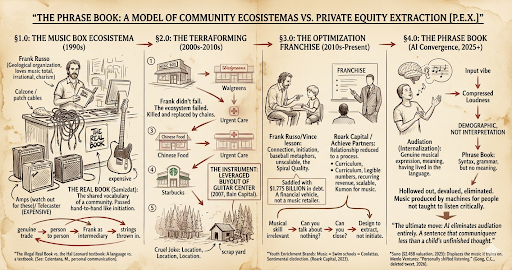
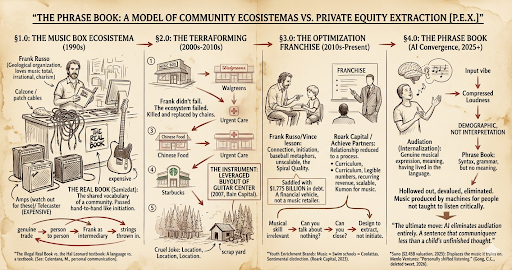
Frank Russo kept The Real Book behind the counter of The Music Box in Hamilton, New Jersey, next to a tangle of patch cables and what I believe was a half-eaten calzone from 1997. To get to the counter you had to step over three amps and watch out for a Telecaster that was, Frank would remind you, expensive. The Music Box was not a store that had been designed. It was a store that had accumulated, the way a reef accumulates—organically, over decades, without a plan or a planogram, governed by the preferences and acquisitional habits of one man who loved music the way some people love their children, which is to say: totally, irrationally, and with an organizational style that could most charitably be described as “geological.”
I was eighteen and had just been accepted to Berklee College of Music—Frank’s alma mater, as it happened. I’d been taking guitar lessons in the back of the shop for a couple of years from a guy named Vince, who once played in a band that opened for a not-yet-world-famous Guns N’ Roses. (RIP Vince.) Frank and I were not especially close, but Frank liked everyone, and when he heard the Berklee news he told me to come behind the counter—step over those amps, watch the Telecaster—because he had something for me.
It was a copy of The Real Book. Not the Hal Leonard version—the real Real Book, the illegal one, the hand-copied, passed-around-like-samizdat compendium of jazz standards that starts with “A Call for All Demons” on page one.[1] He said, “You’re gonna need this and you’ll be using it for the rest of your life.” I am here to report, thirty years later, that he was correct.
The Music Box was a place where you could trade gear. Not “trade in,” the way Guitar Center means it—where they assess your beloved amp at roughly the resale value of a damp sock—but genuinely trade, person to person, your thing for his thing, with Frank as the genial intermediary who’d probably throw in a set of strings because he liked you. Sometimes you could trade your sweat: help him organize the perpetually disastrous state of the shop, move some boxes, untangle the cable drawer, and walk out with whatever piece of gear you’d convinced yourself you needed. You could buy one string if you only had a dollar. You could get back issues of the guitar magazines—probably acquired, like The Real Book, through channels that would not survive legal scrutiny.
There were four or five other stores like this within driving distance. None had Frank’s particular charisma, but they all had their own passionate proprietors who would let you rent a bass for a gig, or a PA for a show your band had booked, because who at that age had a PA? Who knew you even needed one? These were not businesses in the way that a PE analyst would recognize the term. They were ecosystems. They were the places where the musical community of a mid-sized New Jersey town actually lived.
* * *
The Music Box closed around the beginning of COVID, but it had been dying for much longer than that. Its history, in its final two decades, can be told entirely through its addresses. The first location—the one I knew, the one with the Telecaster and the calzone—became a Walgreens. The second became an urgent care. The third, a Chinese food restaurant that is now also an urgent care. The fourth: a Starbucks. And the fifth, the last one, the final indignity—Frank had been relegated to renting a spot behind an auto scrapyard, which was itself behind a large stand of trees, on a road that nobody, and I mean nobody, ever suspected of harboring a business of any kind. Location, location, location had become, at this point, a kind of cruel joke.
But here is the thing that needs to be understood: Frank didn’t fail. The ecosystem failed. Or rather, the ecosystem was killed and replaced with a different one—one in which the only organisms that can survive are those adapted to the logic of extraction rather than the logic of community. Even blue-collar Hamilton became hospitable only to chains, to corporations backed by what I’ll call PE-adjacent finance. Hamilton is, today, almost 100% chains. You will not find a family business. The landscape has been terraformed.[2]
And the instrument that did much of this terraforming—not the only instrument, but the loudest—was the leveraged buyout of Guitar Center by Bain Capital in 2007.[3] What Bain did to Guitar Center is now a well-documented case study in the PE playbook: acquire, load with debt, extract fees, let the host organism stagger under the weight of the parasite. But what gets less attention is what it did to the culture of music retail—which is to say, to the Frank Russos of the world. Because when Guitar Center, the nation’s largest instrument retailer, transforms from a place where musicians work into a place where salespeople work, it doesn’t just change one company. It changes what music retail means. It resets the expectations of every musician who walks through the door.
I know this because I applied for a job at a Guitar Center in San Jose, California, sometime around 2013. I needed a job. I was a Berklee-trained guitarist living in the Bay Area. I figured: music store. Makes sense. The “interview” was a group affair—about twenty-five of us in a room—and I figured out very quickly that musical skill, musical knowledge, musical anything was not what they were after. They wanted to know if you could sell. Could you talk about nothing at all and still run your yapper so fluently that the other person couldn’t get a word in edgewise? Did you have energy? Could you close? I did not get the job, which in retrospect was a mercy, but the experience crystallized something for me: this was a place that had been designed, from the inside out, to extract money from musicians as efficiently as possible, and the one thing that would interfere with that extraction was an employee who actually knew something about music and might, God forbid, develop a relationship with a customer.
Frank Russo gave me The Real Book because he wanted me to have the language. Guitar Center wanted to know if I could run my yapper. One of these is initiation. The other is extraction. They are not on the same spectrum.
There is one non-chain music shop left in the area. It has survived, miraculously, largely because the family that runs it had the foresight to buy their building—which is to say, they removed themselves from the rent economy that PE reshapes in its own image. The employees are helpful and friendly. But it is a different creature from what Frank built. They sell hundred-dollar cables, because that’s where the margins are—they are selling to a different clientele than the musicians of the 1990s, the ones who came in with a dollar for a single string and left with a story. You can survive the new ecosystem, but you cannot survive it unchanged.
* * *
It was around 2013, and I was teaching guitar lessons in the San Francisco Bay Area. Tech optimism was near its apex. People were still moving to Palo Alto and Mountain View hoping to strike gold, and daily I’d hear about someone who’d sold their company for a godzillion dollars even though their one product was a freely downloadable app that would help you organize your spice rack, or something. The prevailing theology was optimization—the conviction that every human activity could be measured, improved, and scaled, and that any activity resistant to this process was simply awaiting the right algorithm.
A couple contacted me about guitar lessons for their twelve-year-old son. I’ll call him Arun. His parents explained that he had “openings in his schedule” that they wanted to fill with something “useful.” The phrasing is worth pausing on. Not free time. Not an afternoon with nothing to do. Openings in his schedule. A twelve-year-old’s life described in the language of calendar management. The schedule was the primary structure; the child existed within it.
Arun was great. Smart, curious, excited to be holding an electric guitar, full of questions, a genuine lover of music. We started learning some Green Day songs—he wanted to play punk, which is a beautiful impulse in a twelve-year-old, the desire to make loud simple joyful noise—and we were making real progress. About two months in, his mother sat me down.
She had a doctorate in computer science and an MBA from Stanford. She and her husband had moved from India to Palo Alto, she explained, in order to be part of the gold rush. They were there to make as much money as possible, in whatever ways necessary. This was not whispered or hedged; it was stated plainly, as a reasonable life philosophy, which in that zip code it effectively was. Fine, I thought. Different strokes.
After balking—twice—about prepaying for lessons on a monthly basis, she wanted to tell me about Arun’s other activities. I was curious. The kid was genuinely interesting, even for a twelve-year-old. I use a lot of sports metaphors when I teach, because playing an instrument is, after all, a physical act of the body, so I asked if he played any sports. He loved soccer and baseball, she said. But they were making him give up both in favor of badminton.
Badminton.
Not because he’d asked. Because that’s “what schools like Stanford were looking for.” He could also choose volleyball, she assured me, for the same reason. The child’s actual desire to play the sports he loved was, in this calculus, a data point to be overridden by a more useful signal.
Then she asked the question I’ve come to recognize, over twenty-five years of teaching, as the one that tells you everything: “So when will he be able to play?”
We were making good progress by any reasonable metric. Arun could play power chords, switch between them at tempo, keep a steady rhythm. But he was months, maybe years, away from sounding like a believable pop-punk guitarist—which is the kind of sentence that, in a culture of optimization, reads as a damning inefficiency. When I tried to explain how learning music actually works—the spiral quality of it, the way you arrive at a place and then have to circle back to a place you thought you’d already covered, only to find it completely new because you’re a different player than you were the first time, the spiral ever-expanding, the “old” stuff always actually new—his mother was not especially happy with my inability to ascribe any metric to his progress other than “sounds good” or “doesn’t.”
I remember one lesson where we were working on his tone, which was brittle—the notes were technically correct but they sounded like they were being poked at rather than spoken. I told him about the batter’s box. When you see a pitch coming that you think you can hit, you don’t stick the bat out and wait to see if the ball contacts it and then finish the swing. You swing with everything you’ve got. You swing through. Same with a guitar pick—you attack from the elbow, and you drive straight through that string with no question and no qualms. Yeah, sometimes you miss. Sometimes you hit the wrong string. But that’s what practicing is. Practicing is learning what it should feel like to hit the right string, with the pick at the right angle, with the right amount of conviction. And you know you’ve hit a home run when that string positively sings.
That is not a lesson you can deliver through a franchise curriculum. It is not scalable. It depends entirely on the fact that I knew this kid played baseball, that I’d heard his specific brittle tone that day, that I chose thismetaphor because it was the one that would land for him. It is a moment of teaching that exists in the relationship between two people in a room, and it cannot be reproduced any more than a conversation can be reproduced. You can transcribe a conversation, but the transcription is not the conversation.
Lessons continued for another six months or so, until the family went to India on vacation. I received a text explaining that they wouldn’t be continuing during the school year. Arun was going to Kumon instead. Better for the college application, I suppose.
I tell this story not to mock Arun’s parents, who were doing what the system they’d entered demanded of them. I tell it because private equity has now arrived to industrialize exactly their logic. In 2023, Roark Capital—through its Youth Enrichment Brands platform—acquired School of Rock, the country’s largest music lesson franchise.[4] In January 2025, a New York PE firm called Achieve Partners bought the digital education division of Wise Music Group—MusicFirst, Charanga, Auralia, Musition—platforms used by over 70,000 music teachers in classrooms around the world. PE didn’t create the optimization mindset that Arun’s mother carried with her from Stanford to my lesson room. PE smelled it, recognized the addressable market, and built the infrastructure to scale it.
The franchise model for music education works the same way the franchise model works for everything: you take a relationship—which is what a lesson is, at bottom—and you reduce it to a process. You create a curriculum that any adequately trained instructor can deliver. You measure progress with assessments that produce legible numbers. You create a thing that a parent with an MBA can evaluate on a quarterly basis. And in doing so, you remove from the equation the only part that actually matters: the teacher who knows that thiskid needs a baseball metaphor, not a chart.
* * *
So. You hollow out the places where musical knowledge lives. You systematically devalue the teaching of that knowledge. And then—and only then—are you ready for the final stage: eliminating the musician from the process entirely.
This is where the argument could, if I’m not careful, slide into the kind of Luddite grandstanding that makes readers reach for the “back” button, so let me try to be precise about what I’m saying and what I’m not.[5] I am not saying that artificial intelligence has no role in music. I am saying that the AI music tools currently attracting the most capital—and it is an extraordinary amount of capital—are designed not to aid musicians but to replace them, and that the distinction is not a matter of interpretation. It is a matter of reading the investor pitch decks.
Suno, the most prominent AI music generator, raised $250 million in a Series C round in late 2025, valuing the company at $2.45 billion. It has two million paid subscribers and generates $300 million in annual recurring revenue. According to an investor pitch deck obtained by Billboard, Suno generates a Spotify catalog’s worth of music every two weeks and plans to launch a social media service. It has admitted training its models on copyrighted music and was sued by Universal Music Group, Sony Music, and Warner Music Group in 2024. (Warner subsequently settled and signed a deal with Suno. Sony and Universal’s suits remain active. Independent artists have filed their own class action. GEMA, Germany’s music rights society, sued Suno in January 2025. The Danish rights society Koda followed in November. The U.S. Copyright Office released a report in May 2025 concluding that fair use does not excuse unauthorized training on expressive works. None of this has slowed the funding.)
Meanwhile, Deezer—the French streaming service that has been the most transparent about the scale of the problem—reported that by November 2025, more than 50,000 fully AI-generated tracks were being uploaded to its platform every single day. That number had been 10,000 in January. It was 20,000 by April, 30,000 by September. By November, fully AI-generated music accounted for 34% of all new music delivered to the service. More than a third.[6] And seventy percent of the streams on those AI tracks were fraudulent—bot networks inflating play counts to siphon royalties from the same pool that pays human musicians.
Sony Music has requested the removal of more than 135,000 AI songs impersonating its artists. After the music data service Anna’s Archive breached Spotify’s database in December 2025—extracting metadata for 256 million tracks—industry observers warned that attribution and enforcement may soon become practically impossible.
These are the conditions. Now let me tell you what it sounds like from the inside.
I uploaded a two-track recording to Suno—a rhythm guitar and a lead guitar playing a melody, along with lyrics I’d written on the spot. These were my guitar parts. My words. I wanted to know what the machine would do with something that was, however modest, a genuine musical expression—something I’d played with my hands and thought about with my brain and felt in whatever place it is where musicians feel things.
Suno spat out two versions. Both had the compressed, maxed-out loudness of a song engineered to sound good on earbuds in a moving car—every frequency filled, every silence paved over, the audio equivalent of a room with no windows. The algorithm had decided—based, apparently, on the “vibe” of my lyrics—that the song should be a mashup of alt-singer-songwriter and Taylor Swift: a mishmash of pop corniness and playlist-friendly tripe. A soaring AI voice, sure. But performing what, exactly? For whom? The song had been optimized into a demographic, not interpreted into a performance.
And here is the thing I need to say very carefully, because it is the crux of the matter: it sounded great. It sounded polished and professional and radio-ready. And I hated it. I hated it the way you hate a perfectly grammatical sentence that says absolutely nothing—a sentence with subjects and verbs and punctuation, all in the right places, that somehow communicates less than a child’s unfinished thought. It had all the phonemes of music. It had the syntax, the prosody, the surface grammar. What it did not have was meaning. It was a phrase book. It was what you get when you feed the entire history of a language into a machine and ask the machine to produce sentences without ever having had a thought.[7]
* * *
I said at the beginning of this publication’s life that music is not metaphorically a language but structurallyone—that the parallels between pitch and phoneme, rhythm and syntax, harmony and grammar are not decorative but load-bearing. I want to spend a moment now on why that thesis makes the PE/AI convergence not just troubling but existentially dangerous to something that matters.
When you learn a language—a real one, not a phrase book—you do not begin by producing fluent sentences. You begin by listening. By babbling. By getting things wrong in ways that teach your ear what right sounds like. You develop, slowly and in spirals, an internal sense of the language’s logic—its grammar, its idioms, its rhythms, the way it breathes. This is what linguists call internalization and what music educators call audiation: the ability to hear music in your mind before you produce it with your body. It is the thing that makes you a speaker of the language rather than a reader of the phrase book.
Everything PE does to music attacks audiation. The hollowing-out of music retail removes the community where musical knowledge circulates informally—the Frank Russos who hand you The Real Book and say you’re gonna need this. The franchising of music education replaces the teacher’s ear with a curriculum’s metric, optimizing for measurable progress rather than the unmeasurable development of an internal musical ear. And AI music generation is the final move: it eliminates the need for audiation entirely by producing music that sounds like someone meant it without anyone having meant anything at all.
The result—and this is not a prediction; this is happening now—is a culture in which music is increasingly produced by machines, consumed by people who’ve never been taught to listen critically, and sold through platforms that are financially incentivized to treat human-made and machine-made content identically. It is a culture that has, in the language metaphor, stopped teaching its children to speak and started handing them phrase books and saying: this is the same thing.
It is not the same thing. And the people making billions of dollars from the confusion are counting on you not being able to tell the difference.
* * *
I have a student—I’ll spare him the publicity—who can actually play quite well. He improvises solos, navigates chord changes, moves around the fretboard with genuine facility. But for a long time, the actual picking of the notes—the moment where the pick meets the string and a sound is born—was an afterthought. A necessary evil. A note was either picked or it wasn’t. Binary. On or off.
So I brought to his attention—because you don’t teach these things, exactly; you bring them into the light and then you stand there together and look—that there was an entire universe right there, in the space just above the string and just below it. That what happens in that space, in that split second of contact, determines the story you’re telling. It is your voice. So bother to pay attention to it.
We worked on the angle of pick attack. Hit the string with the edge of the pick more than with the face. Get it to go fffwip fffwip, not ping pink or twack tink. Bother to pay attention. That’s your sound. Not the intricate finger patterns on the fretboard, not the complex key changes in the chord progression. One note at a time, each one played with attention.
You can sort of measure it—you can talk about pick angle, arm speed, wrist rotation. But the proof is always and only in the sound you produce. In the word you say. And no algorithm will ever say it for you, because saying it requires having something to say, and having something to say requires having lived in the language long enough to know what you mean.
There is an entire universe in the space just above the string and just below it. Frank Russo knew it was there. He handed me a book and said you’re gonna need this. No pitch deck. No KPI. No exit strategy. Just a man in a cluttered shop, handing a kid the language, and trusting him to learn to speak it.
A phrase book will never find that universe. But if you bother to pay attention—if you have a teacher, and a room, and a guitar, and the willingness to swing and miss and swing again—you will. You will hear it. And when you do, you will know the difference between a sentence that means something and one that doesn’t, no matter how good the grammar is. That’s the whole thing, really. That’s what there is to protect.
if this essay did something to you — cracked something open, confirmed a suspicion you'd had for years but never had words for, or simply made you feel less alone in your relationship with music — there's more where that came from. music as language is a publication about exactly what it sounds like: the idea that music isn't a metaphor for communication, it is communication, and that every person alive is already fluent in ways they haven't yet been told. new essays arrive when they're ready, which is to say: not on a schedule, but not randomly either — the way a good melody arrives. subscribe at michaelcelentana.substack.com and i'll meet you there.
[1]The Real Book’s history is itself a miniature version of this essay’s argument. For decades, it circulated as an illegal, hand-copied compendium of jazz standards—Berklee students photocopying photocopies, each generation a little more smudged, passed hand to hand like samizdat. It was, in every meaningful sense, the shared vocabulary of a musical community, and its slightly-illegal, passed-around-in-backpacks, don’t-let-the-publishers-see-this quality was part of what made it feel like initiation rather than purchase. Then Hal Leonard got hold of it, filed off the rough edges, corrected the “mistakes” that working musicians had long since incorporated into their understanding of the tunes, and published a clean, legal, shrink-wrapped version. The Hal Leonard edition is, by any objective measure, a better product. It is also, by any honest reckoning, a lesser object. The difference is the difference between a language and a textbook.
[2]I should be transparent about my own position here, lest this start to sound like the unexamined nostalgia of a guy who peaked in the ’90s. I am a guitar teacher who runs a small studio. I am, in PE terminology, a “solo practitioner” operating in an “unscalable” model. I have a dog in this fight and that dog is, increasingly, underfed. But I also have 25 years of evidence about what actually works in a lesson room, and it is not the thing that franchises.
[3]The Bain Capital playbook, for those mercifully unfamiliar: a private equity firm makes an offer to buy all shares of a company’s stock, then loads the company itself with debt to finance much of the sale. This is called a “leveraged buyout,” which is a polite way of saying they bought your house with your own mortgage and then charged you rent. Bain saddled Guitar Center with a $650 million term loan, $750 million in notes, and a $375 million credit facility. The company never recovered. It existed, for the next thirteen years, not as a music retailer but as a financial vehicle—a thing to stuff with debt, financing fees, and consultancy bills while it shuffled toward an inevitable collapse that finally arrived in November 2020. Bain Capital, for the record, is the same firm that acquired Warner Music Group and Toys “R” Us. The latter is now dead. The former survived, barely. Guitar Center, as of this writing, remains technically alive, in the way that a patient on a ventilator is technically alive.
[4]Roark Capital, for context, also owns Inspire Brands (Arby’s, Dunkin’, Sonic, Buffalo Wild Wings), Focus Brands (Cinnabon, Auntie Anne’s), and Driven Brands (Meineke, Maaco). The operating assumption appears to be that teaching a child to play guitar is, at a fundamental level, the same kind of business as selling a Coolatta. I am not being glib. This is literally their thesis: Youth Enrichment Brands groups music education alongside swim schools and youth sports leagues because all of them are “youth activities” with recurring revenue and franchise-scalable delivery models. That the content of the activity—swimming versus music versus soccer—might matter is, from the PE vantage point, a sentimental distinction.
[5]I want to be fair here, because fairness is what separates an argument from a rant. Is there a twelve-year-old in rural Mississippi right now who has no access to a music store, no teacher within fifty miles, and who is using Suno or Moises or some AI tool to engage with music in a way that would otherwise be impossible? Almost certainly. Are there working musicians using AI stem separation to learn solos, or using generative tools to sketch arrangements before bringing them to human players? Of course. The technology is not, in itself, the problem. The problem is who funds it, what they optimize for, and what has to die in order for their model to work. Moises, for instance, is genuinely useful—it lets you isolate instruments in a recording so you can hear a bass line or a vocal in solitude. But it is, as I tell my students, like having all the tools of a carpenter without knowing how to build anything. The tool is only as good as the ear using it, and the ear is only as good as the education behind it, and the education is being bought up by PE firms who compare it to Kumon.
[6]In a Deezer-commissioned Ipsos survey of 9,000 people across eight countries, 97% of respondents couldn’t distinguish between fully AI-generated tracks and human-made music in a blind listening test. Eighty percent said they wanted AI-generated music to be clearly labeled. Sixty-nine percent agreed that payouts for AI-generated music should be lower than for human-made music. In other words: people care. They just can’t tell. This is not a failure of the ears. It is a failure of education—of a culture that has, for decades, systematically devalued the teaching of musical literacy in favor of things that are easier to measure.
[7]In February 2026, Suno’s lead investor at Menlo Ventures, C.C. Gong, tweeted that she had “personally shifted most of my listening to Suno” because she was “tired of Spotify giving me the same overplayed recommendations.” She deleted the tweet. Ed Newton-Rex, founder of the nonprofit Fairly Trained, noted that this was Suno’s own investor admitting that the product displaces the very music it was trained on—the thing Suno’s legal defense explicitly denies. A writer named Tim Requarth observed that Gong’s “democratization” pitch works because it quietly equates what a person does with a text prompt and what Charlie Parker did in New York City, as if they’re different points on the same spectrum. They are not.