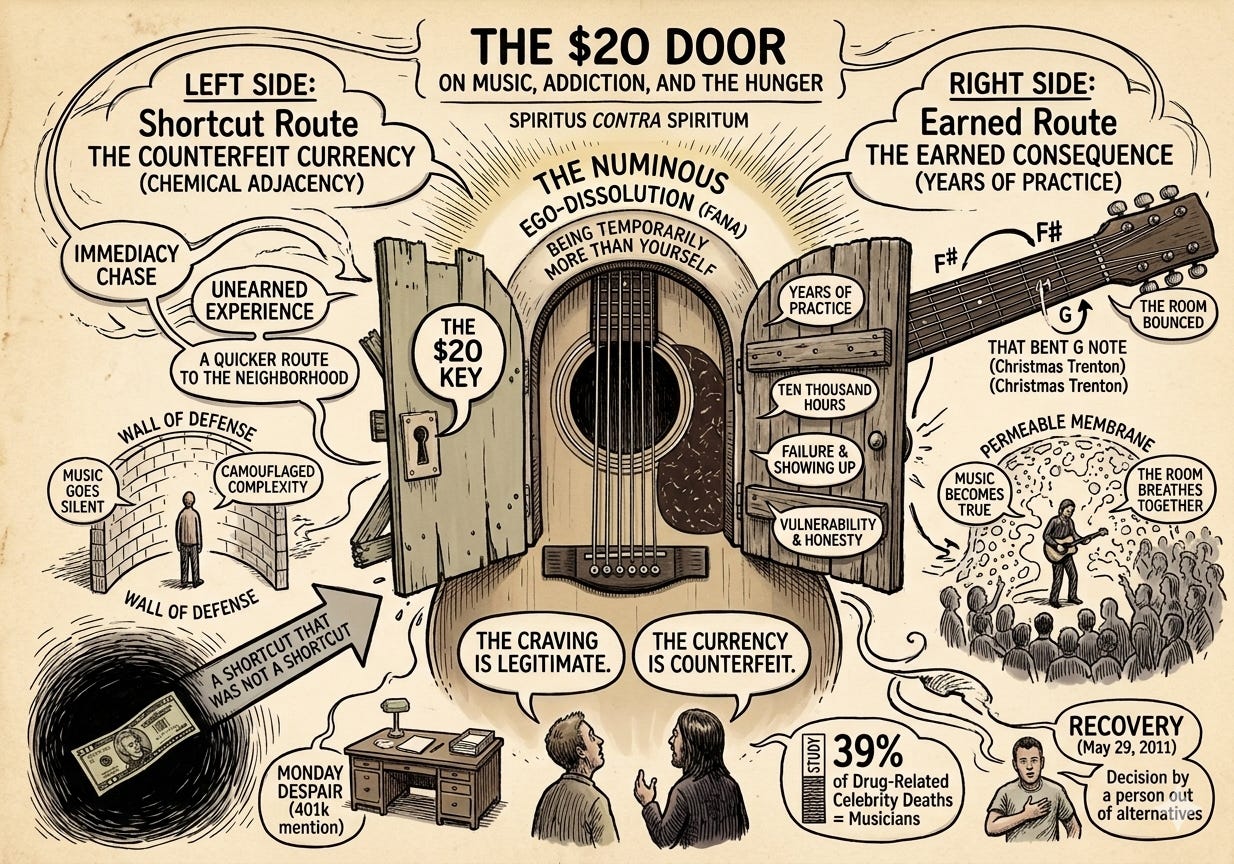
The $20 Door
On Music, Addiction, and the Hunger That Drives Both
There is a statistic that gets passed around in certain conversations — the kinds of conversations that happen at music industry panels, or in the waiting rooms of rehabilitation facilities, or in the particular species of obituary that gets written when another musician dies at an age that would have been unremarkable for a dentist — which holds that musicians account for nearly forty percent of all drug-related celebrity deaths.1 Forty percent. This is, depending on your relationship to the music industry, either shocking or completely unsurprising, and the fact that most people with any proximity to that world land firmly in the second camp is itself worth pausing on.
The explanations that get offered are not wrong, exactly. They are just insufficient in a way that feels important. The hours are irregular. The environments are saturated with available substances. The psychological violence of public failure — of playing badly in front of people who paid to watch you play well, or worse, of playing brilliantly in front of people who are talking over you — is real and specific and not adequately addressed by most employee assistance programs. Performance anxiety is a genuine clinical phenomenon. The music industry, taken as a social ecosystem, is not what you would design if your primary concern were the long-term neurological health of its participants.
All of this is true. None of it is the point.
The point — the thing that the lifestyle explanation and the pressure explanation and the access explanation all fail to account for — is that musicians are not, as a category, people who stumbled into substance use because their circumstances made it available and their stress levels made it appealing. They are people who already knew, before the first drink or the first line, what it felt like to be temporarily freed from the ordinary boundaries of the self. They knew what it felt like because music had shown them. Music had taken them there, repeatedly, through the long and effortful and occasionally transcendent process of learning to play — and then, at some point, something else offered to take them back for considerably less effort and a much smaller financial outlay.
This is the part that doesn't make it into the obituaries.
What I want to suggest — and I recognize this is the kind of claim that requires some evidence, which I will provide, and some personal testimony, which I will also provide, and a brief detour through the correspondence of Carl Jung and the devotional music of the Sufi tradition, which I will get to in due course and which I promise is relevant — is that the connection between musicianship and addiction is not incidental. It is not a lifestyle problem or a personality problem or a problem that better industry mental health resources would meaningfully address, though better industry mental health resources would not hurt. It is, at root, a problem about a specific human hunger: the hunger for absorption into something larger than the self, for the dissolution of the boundary between the individual consciousness and whatever is outside it, for the experience — fleeting, physical, unmistakable — of being temporarily more than yourself.
Musicians are disproportionately vulnerable to addiction because music, practiced seriously and with full attention, is already a consciousness-altering act. It already takes you there. And once you know where there is — once your nervous system has the address — the temptation to find a faster route is not a character flaw. It is an entirely logical response to a piece of information your body now permanently holds.
To understand what I mean, you need to come with me to a bar in Trenton, New Jersey, on Christmas night, 2002.
* * *
I. Christmas, Trenton, and the Thing Itself
There is a bar — was a bar, technically, since it has since been claimed by the particular entropy that eventually claims all genuinely good things, which is a pattern so consistent it almost suggests intention — called Joe's Mill Hill Saloon, on South Broad Street in Trenton, New Jersey, operated by a man named Denny whose management philosophy could be summarized, without meaningful distortion, as: I have had a fourteen-hour day, here are the keys, please do not burn this place down.2 Denny's confidence in us was either an expression of his fundamental decency or a consequence of his fundamental exhaustion, and I have never been entirely sure which, and I'm not sure it matters.
Us being, at this particular moment in the early 2000s: me on guitar; Ian Budd4 on second guitar; Dave on drums, operating the hi-hat with the judicious restraint of a man who believes percussion is a resource to be conserved, deployed only under conditions of genuine musical necessity, which gave everything we played a quality of controlled wildness that I have never successfully replicated in any subsequent project and have largely stopped trying; and Johnny Hips on bass.3 Johnny Hips is followed, in this essay, by the parenthetical RIP, because he died, because people do, and because he deserves more than a parenthetical but this is what I have to offer at present and I am offering it.
We were called Wesley Walker and the Deluxe Vibrations. Wesley Walker was a wide receiver for the New York Jets, notable primarily — perhaps exclusively — for having played an entire NFL career with functional vision in only one eye, a fact that Ian, as a Jets fan of the suffering and devoted variety, found cosmically significant.5 There was no Wesley in the band. This seemed, at the time, beside the point, which tells you something about the time.
We had no songs.6
What we had instead was a collective willingness to fall off whatever musical cliff presented itself on a given Tuesday or Thursday, and the tacit, never-articulated agreement that the other three would fall with you. Our sound — and I use sound loosely, the way you might use cuisine to describe what emerges when four people who've raided different refrigerators all cook at once — pulled from Phish-adjacent jam noodling; from John's inexplicable and magnificent devotion to Sly and Robbie's dub architecture, which meant that any given evening might suddenly become a live reggae experiment, without prior notice to anyone, including John; from Dave's hi-hat philosophy, previously described; and from my own fresh-out-of-Berklee compulsion to demonstrate, to anyone within earshot and several people who were actively trying to be out of earshot, that I had in fact studied the Real Book, via a pedalboard driven well past the outer limits of its manufacturer's intentions. Reverb so wet it dripped. Infinite delays looping around the room like confused and beautiful pigeons. Fuzz so dense you could lean against it, which, on certain nights, people practically did.
On a good night, we sounded like Sonic Youth had wandered into a late Coltrane session and everyone had mutually decided to see what happened. On a less good night, we sounded like exactly what we were: four people who had never rehearsed, playing instruments that cost, collectively, more than our rent, in a bar whose owner had gone home and trusted us not to do anything irreversible. We also had, on various occasions, Kenny on trumpet, who would appear without warning and play with the confidence of a man who had been expecting to be called; and Farrell, who would sometimes set up his turntables — three of them, because Farrell was not a person who believed in doing things at the scale at which they strictly needed to be done, and also because three turntables meant he could stay two songs ahead while mixing, which is either overindulgence or genius and is, on reflection, both — and transform the whole enterprise into a live hip-hop band, complete with guest rappers who were, and I want to be precise here, genuinely good — not good-for-Trenton good, not good-considering-the-circumstances good, but actually, unqualifiedly, should-have-been-famous good, which is its own kind of heartbreak and also its own kind of miracle.
Christmas night. 2002, or close enough — the specific year has the quality of a photograph left too long in a sunny window, vivid in the center and blurring badly at the edges, but the emotional temperature of that particular night is as precise and retrievable as anything I own.7 Christmas in these parts operated, and still operates, according to a tradition so deeply embedded it barely requires articulation: once the family obligations have been discharged, the gifts appropriately admired, and the acceptable window for remaining at your parents' house without it becoming A Thing has elapsed, everyone goes out. And by everyone I mean, with only slight exaggeration, everyone. The Mill Hill was packed — packed with people in their Christmas best, warm from the family wine, radiating the specific quality of goodwill that exists only in the narrow window between the completion of gift-giving and the beginning of thinking seriously about the drive home. It was, and I am going to use this word despite its inherent imprecision, magical, in the same way that certain combinations of people and place and timing produce something the individual components could not have predicted, which is either what magic is or a reasonable facsimile thereof.
We launched into our first set — which was not a set so much as one continuous, unplanned, collectively improvised act of musical free association, the sonic equivalent of a conversation where everyone is simultaneously listening and talking and somehow, on the good nights, something coherent emerges — around ten o'clock. And from, essentially, the first note, we were locked in.
There is a thing that happens, occasionally, when musicians who know each other well enough are also loose enough and present enough and, frankly, lucky enough: the individual selves begin to recede. The planning apparatus — the part of you that is always monitoring, always evaluating, always preparing the next move while executing the current one — goes quiet, or quiet enough, and something else moves into the space it leaves behind. You stop deciding what to play and start receiving it. The music stops being something you are making and becomes something you are participating in, the way weather is something you participate in rather than make, except that in this case you are somehow also the weather. This is difficult to describe without sounding like someone who has recently attended a retreat of some kind, which I have not, or not recently, but I am going to ask you to stay with me because the difficulty of the description is not evidence of its inaccuracy.
On this particular Christmas night, we got there almost immediately, which almost never happens, and which I have spent twenty-some years trying to understand and cannot.
Over the course of three or four minutes — though time, in this state, does the thing it does in dreams, which is to become simultaneously very slow and irrelevant — the music built. Not because any of us decided it should build. Because it wanted to, in the same way that a sentence sometimes wants to go somewhere the writer didn't plan, and the only skill involved is the willingness to follow it. The energy rose and tightened and spiraled upward, and at a certain point I became — this is the part that usually kills it — conscious of what was happening. I caught myself watching myself play, which is the musical equivalent of a tightrope walker suddenly thinking about the tightrope, or a centipede attempting to consciously coordinate its legs, or any number of other metaphors for the way that self-awareness, introduced at the wrong moment, is the specific thing that destroys the state it's observing.
Not too much, Michael. Short phrases. Let it breathe the way it wants to breathe. Follow your bandmates. Respond to them — but not too much, not everything at once, don't play the whole sentence when a word will do, don't —
And then the moment arrived. The moment when the build had built as far as it was going to build, and the music was waiting, with what I can only describe as patience, for someone to do something about it. I slid up the neck to the land of the tiny frets — the high register where the guitar gets bright and declarative and stops being able to hide behind texture — and I found an F#, and I bent it up, slowly, to a G, and I held it there, and I made it sing.
The room bounced.
Not metaphorically. The people — the bodies that collectively were the room — moved upward and then back down, all at once, the movement of a single organism responding to a single stimulus, which is either a description of what music can do at its best or a description of what it's always doing and we're usually just not paying close enough attention to notice. And from the front row, a friend named Regan — and hello, Regan, if you're reading this, and I hope you are — produced an Ohhhh of the specific register and duration that communicates not pleasure exactly but recognition, the sound a person makes when something confirms what they already suspected but hadn't been able to articulate. I can reproduce that sound in my head with a fidelity that embarrasses, frankly, the amount of Berklee ear training I retained.
The four of us looked at each other. We were each wearing the same expression, which was the expression of people who have just been somewhere they were not entirely sure they were authorized to go, and have come back, and are not yet sure what to do with what they brought with them. Rictus grins. Wide eyes. The residue of something.
The music had not been ours. We had been in it — vessels, maybe, or temporary custodians of something that was moving through the room and through the bodies in the room and through the instruments and through the specific frequency of goodwill that a packed bar in Trenton generates on Christmas night — but it had not been ours in the way that a song you composed and rehearsed and know by heart is yours. It belonged to something larger than any of us, including all of us together, and that is either what the word spiritual means or it is the closest I can get to what the word spiritual means, and I am going to use it, and I am going to ask you, one more time, to stay with me.8
Afterward — and here is where the essay actually begins, though everything above is necessary context — there were hugs and high-fives (the fist bump had not yet entered popular parlance, it being 2002). I felt invincible. I felt like I had been handed a piece of information so important that everything preceding it retroactively reorganized itself around the new fact. I knew, in the way you only know things that arrive through the body rather than the mind, what music was for.
The following Monday, I went to my office job. I sat at a desk. Someone mentioned a 401(k).9
I was not philosophical about this. I was angry — specifically and genuinely angry, the way you are angry when you know something beautiful exists and you are being asked, by the logic of ordinary adult life, to pretend you don't. I could not square the two things. I still can't, really. I can manage them, the way you manage a chronic condition, but the fundamental incompatibility has not resolved.
Because here is what I knew, sitting at that desk: the experience I'd had — the absorption into something larger than myself, the dissolution of the membrane between the music and the room and the bodies in the room and the specific night — that experience was available. It was real. It was, as far as I could tell, the most important thing the human body is capable of doing with its short time on earth.
And then someone offered a person like me — someone who already knew what that felt like — a $20 shortcut to something adjacent.
This is where the story gets complicated.
* * *
II. Spiritus
The data is real, if imprecise. Musicians account for nearly 39% of all drug-related celebrity deaths in studies tracking such things — more than actors, writers, athletes, or any other category of person whose obituary gets written in Rolling Stone. The arts and entertainment industry as a whole shows substance use disorder rates placing it third highest among all industries tracked by the Substance Abuse and Mental Health Services Administration. A 2019 survey found that 73% of independent musicians report symptoms of mental illness — anxiety and depression, predominantly — in direct relation to their work.
The standard explanatory framework trots out, at this point, a reliable cast of contributing factors: irregular hours, performance pressure, social environments awash in available substances, the peculiar psychic violence of public failure. These are real. They are also, I want to suggest, downstream of something more fundamental — something that the data can point at without quite being able to name.
Carl Jung named it, or tried to. He called it the numinous — the encounter with something that temporarily dissolves the boundary between the self and whatever is larger than the self. It is, in Jung's account, what genuine religious experience feels like from the inside: not comforting, exactly, but vertiginous; not peaceful, but real, in a way that makes ordinary consciousness feel like a pale draft of the actual document.
Jung corresponded, late in his life, with Bill Wilson — the co-founder of Alcoholics Anonymous, who had gotten sober following what he described as a profound mystical experience: a light, a dissolution, a sense of being temporarily freed from the cage of his own ego. Wilson wanted to know if Jung thought the experience was genuine. Jung's answer was carefully worded and, when you read it slowly, fairly devastating: the craving for alcohol was, at depth, a craving for spiritus — for spirit, for the numinous, for precisely the dissolution Wilson had eventually found through sobriety rather than through the bottle. The Latin word for alcohol and the Latin word for spirit are, Jung observed, not coincidental. They are the same word.10
The Sufis understood this at least eight centuries earlier, which is either evidence of their wisdom or evidence that the problem is very old, depending on your mood. Qawwali music — the devotional music of Sufi mysticism, practiced most transcendently in the twentieth century by Nusrat Fateh Ali Khan — is not incidentally moving in the way that a well-produced pop song might be incidentally moving. It is engineered for ego-dissolution. The drone, the tabla's just-barely-syncopated pulse, the call-and-response, the building repetition: these are technologies for inducing the specific state that Jung called numinous and that the Sufis called fana — annihilation of the self in the divine.11 The ceremony is not a metaphor for the experience. The ceremony is the experience. The music is the mechanism.
I have been able, since roughly age nineteen, to induce goosebumps and a state that I can only describe as gloriously porous simply by listening to Nusrat Fateh Ali Khan. Something in the drone mainlines directly past the cognitive apparatus and lands somewhere in the body that doesn't have a precise anatomical name. On Christmas night at the Mill Hill, playing that bent G, I was in the same room. Different door. Same room.
Neuroscience has, in its careful and footnote-heavy way, begun to confirm what musicians and Sufis and Bill Wilson's sponsor already knew: music-induced euphoria and drug-induced euphoria activate overlapping neural pathways. The reward circuitry is the same circuitry. The dopamine is the same dopamine.12 Which means that the musician who has spent years learning to access that state through practice — through the long, effortful, humiliating, occasionally transcendent process of learning to get out of their own way — has neurologically mapped a territory that certain substances can reach by a different route.
This is not a coincidence. This is the mechanism.
The musician who first gets high is, in a quite literal neurological sense, returning to a neighborhood they already know. The streets are familiar. The address is the same. What they discover, eventually — sometimes quickly, sometimes over the course of years and enormous personal cost — is that the house has been hollowed out. The walls are there. The windows are there. But nothing inside it can be lived in.
Because the experience, arrived at chemically, is wholly unearned.
This is the distinction the addict cannot usually articulate and the musician usually doesn't need to, because the musician has felt both and the body knows the difference even when the mind is working very hard to argue otherwise. The absorption into something larger — the dissolution, the fana, the Christmas-night rictus grin — that state, arrived at through music, through practice, through years of learning to subordinate the ego to the demands of the sound, carries with it a content. A weight. A knowledge that enters through the hands and the ear and the body and cannot be summarized or transferred or reproduced by any other means. You are privy to a world, an experience, a vision that you didn't earn through chemistry. You built the door yourself, over years, one plank at a time, and what's on the other side belongs to you in a way that a $20 shortcut structurally cannot replicate.
The craving is legitimate. The currency is counterfeit.
* * *
III. The Long Road
Here is what I did not understand, for a long time, about the Christmas night: that it was not a gift. That it was, in the most precise sense of the word, a consequence — of years of practice, of failure, of learning to subordinate the thing I wanted to say to the thing the music needed to say, of showing up to gigs in bars that smelled like spilled beer and low expectations and playing anyway. The experience was not handed to me. I had built it, slowly and without fully realizing I was building it, the way you sometimes arrive at a belief you didn't know you held until something happens that reveals it was there all along.
The problem with a consequence is that you cannot shortcut your way to it. The problem with me, specifically, was that I spent the better part of a decade trying anyway.
What alcohol promised — and here I want to be careful, because the promise was not nothing, which is precisely what made it dangerous — was adjacency. Not the thing itself, but the neighborhood of the thing. The loosening. The slight dissolution of the membrane between self and sound. The feeling, arriving reliably after the second drink and beginning to deteriorate reliably after the fourth, of being close to something. And I want to be honest about this: in the early years, it was not entirely a lie. There was a version of the loosening that was real, or real enough that I could not distinguish it from the real thing, which is either a testament to alcohol's mimicry or to my own capacity for motivated self-deception, and I suspect it was both in roughly equal measure.
But the spirit, it turns out, is a more rigorous accountant than the mind. The mind will accept the counterfeit. The spirit will not.
What I noticed — and then spent years trying not to notice, which is its own full-time job and one that does not pay particularly well — was that the music had gone silent. Not literally. I was still playing. I was playing, in fact, quite a lot — amassing scales and licks and chord inversions and theoretical frameworks the way a person amasses possessions when they suspect, somewhere below the level of conscious admission, that they are trying to fill a space that cannot be filled by accumulation. I was getting, by certain technical measures, better. I was getting, by the only measure that had ever actually mattered to me, catastrophically worse.
Because what the accumulation was for — and I knew this, in the way you know the thing you are working hardest not to know — was camouflage. I had little, during those years, to actually say. The music I was making said nothing, and I had dressed it in enough complexity that I could, on most nights, avoid confronting that fact directly. I would sit with an instrument and think, very hard, about some theoretical idea — a particular harmonic substitution, a rhythmic displacement, a voicing I'd been working on — and force it out, and then wonder, with genuine puzzlement that was not entirely performed, why it elicited no response from anyone within earshot. The answer I reached for, with the speed and confidence of a person who has rehearsed it: they just don't understand this. It's too advanced.
This is the oldest lie in the musician's repertoire, and also the most seductive, because it contains just enough truth to be almost sustainable. There is music that most audiences don't immediately understand. There is work that requires an educated ear. The lie is the sequencing — the assumption that complexity precedes communication rather than serving it, that the difficulty is the point rather than the cost. What I was playing during those years was not advanced. It was defended. There is a difference, and the audience always knows it, even when they can't say why, even when all they know is that the music left them cold.
The music had become a wall. On Christmas night at the Mill Hill, it had been a membrane — permeable, dissolving, the room and the band and the crowd all breathing together through it. Now it was a wall, and I was on one side of it, and everyone else was on the other, and I had built it myself and called it artistry.
Time passed. This is the part that is hardest to describe without either sentimentalizing it or making it sound more dramatic than it was, which is to say: it was not dramatic at all. It was quiet. It was the sound of years going by with nothing to show for them — no musical statements worth the name, no real contact with another human being through the instrument, just a vague and increasingly threadbare hope that the thing I was looking for was still out there somewhere, that I was still, somehow, close.
I was not close. I was, in the technical language of people who study such things, and in the more precise language of my own eventual reckoning, an alcoholic. The relationships I sacrificed to this pursuit — the people who got close enough to see what was actually happening and were invited, with varying degrees of subtlety, to leave — are not abstractions. They are specific people with specific faces, and I am aware that some of what I owe them cannot be repaid, and I carry that knowledge the way you carry a thing you have decided not to put down because putting it down would mean pretending it isn't there.
The musical opportunities. The career that did not happen, or happened partially, in the attenuated way of things attempted without full presence. The physical and financial wreckage, which was considerable and the aftershocks of which are, not to be overly dramatic about it, still registering on the relevant instruments. All of this, in service of a shortcut that was not a shortcut to anything. All of this, in pursuit of a door that had stopped opening.
May 29, 2011.
I am not going to make this moment into something it wasn't, which was clean or simple or accompanied by any particular feeling of arrival. What it was, mostly, was a decision made by a person who had run out of alternatives, which is not the heroic narrative but is, I suspect, the accurate one, and accuracy is what I have to offer in place of heroism. What I will say is this: it was the day I stopped lying to the one person the lying had never actually worked on.
What happened to the music after that was not immediate. Nothing about recovery is immediate, which is one of the things nobody tells you and one of the things that would not have deterred me anyway, given that immediacy was precisely what I'd been chasing for a decade. What happened was gradual, and then, in the way of gradual things that have been accumulating quietly, suddenly: the music became true.
Not complex — or not only complex. Not technically accomplished — or not only technically accomplished. True. Vulnerable in the way that things are vulnerable when they are not hiding anything, when the person playing has accepted, finally and without significant remaining resistance, that they are in fact a human being like every other human being, possessed of the same fears and the same hungers and the same need to be heard, and that this is not a limitation to be overcome but the entire basis of the enterprise. Twinkle, Twinkle, Little Star, when it is what needs to be said, is more musical than any harmonic substitution ever devised. Brian Blade knows this.13 Mary Oliver knew this. Every great musician, at some point, has to learn this, and the learning always costs something, and the cost is always worth it, and I wish I had learned it sooner and I am grateful I learned it at all.
Because here is what the music does, when it is honest: it dissolves the wall. Not the membrane — that word implies something more delicate, more mystical, than what actually happens, which is blunter and more physical and more democratic than the word suggests. The wall. The one you built with your scales and your theoretical frameworks and your conviction that the problem was always the audience's limited understanding and never your own limited willingness to be seen. When the music is honest, that wall comes down, and the room — whatever room you're in, the Mill Hill or a living room or a school gymnasium — breathes together, and you are no longer alien, and the thing you have been chasing your entire musical life turns out to have been available all along, on the other side of the one door you kept walking past.
The spirit dictates these rules. Not the mind, which will negotiate and rationalize and construct elaborate defenses against the rules. The spirit. Which knew, the whole time, which door was real.
* * *
Notes
1 The figures cited throughout this essay come from a 2016 study of roughly 250 drug-related celebrity deaths between 1970 and 2015, and from data published by the Substance Abuse and Mental Health Services Administration. The statistic about musicians accounting for 38.6% of drug-related celebrity deaths is one of those numbers that, once you've worked in or around the music industry for any length of time, ceases to be surprising in a way that is itself somewhat alarming.
2 Joe's Mill Hill Saloon deserves a more complete obituary than I am able to provide here. It was a railroad-style barroom on South Broad Street in Trenton, NJ, and it is no longer operating, which is the fate of all genuinely good bars and none of the bad ones. Denny never made a cent on our nights there, a fact I attribute to the social logic of our audience, who treated the first drink of any given evening as the last drink they would need to pay for. This logic was impeccable and financially ruinous in equal measure. It was, in the specific and irreproducible way of places that existed before everyone was chronically online, a place you simply had to be there to understand, and I recognize that this is exactly the kind of thing people say about places that cannot be adequately described, and I am saying it anyway because it is true.
3 Johnny Hips earned his name through a bass-playing style that was, to put it charitably, physical — a full-body commitment to the low end that involved, on any given night, a significant amount of hip movement. He was an extraordinary musician whose relationship to Sly and Robbie's dub architecture informed everything we played, usually without warning and always to good effect. He is missed.
4 The author wishes to state, for the record, that Ian Budd's surname and its relationship to the subject matter of this essay is a coincidence so perfect it would be rejected as too on-the-nose in a work of fiction. Ian is, to the author's knowledge, a person of entirely sober disposition. The name simply arrived this way, which is either evidence of the universe's sense of humor or its indifference, and the author has not decided which.
5 Wesley Walker played for the New York Jets from 1977 to 1987, catching 438 passes for 8,306 yards over a career that would have been remarkable for a player with full binocular vision and was genuinely extraordinary for one without it. The ability to track an oblong leather ball through the air and calculate, below the level of conscious awareness, the precise intersection of one's own trajectory and the ball's — this requires depth perception that Wesley Walker did not technically have and managed anyway. Ian found this inspiring in a way that extended, in the band-naming session in question, well past what most people would consider reasonable. Ian was correct.
6 This is not false modesty or artistic posturing. We had, across the full run of the Deluxe Vibrations' existence, approximately zero songs. What we had were tendencies — recurring sonic neighborhoods we liked to visit, a shared vocabulary of gestures that could be assembled, on a good night, into something that resembled structure from the inside even when it resembled nothing from the outside. This is either a description of free improvisation or a description of conversation, and the overlap between those two things is, not coincidentally, the subject of this entire essay series.
7 The blurring of specific dates in this period is not, I want to clarify, a consequence of the lifestyle under discussion. It is a consequence of being in one's early twenties, which produces its own species of temporal distortion entirely without chemical assistance. The emotional content of those years is vivid and retrievable. The metadata is not.
8 I am aware that spiritual is a word that has been so promiscuously deployed by people describing everything from yoga retreats to particularly good avocado toast that it has lost considerable precision. I am using it here in the specific Jungian sense: an encounter with the numinous, a temporary dissolution of the ego-boundary, the experience of being porous to something larger than the self. If this seems like an overstatement for a bar band playing for a room of boozed-up Trentonians on Christmas night, I would gently suggest you have not spent enough time in the right bars.
9 I want to be clear that I understand, intellectually, the importance of retirement savings. I have, at various points in my adult life, even contributed to one. I am not arguing against financial planning. I am arguing that there exists a specific species of despair — clean, bright, particular — that arrives on the Monday morning after a transcendent musical experience, when the first item of business is a conversation about deferred compensation. This despair has not been adequately documented in the financial planning literature, and I consider that a gap.
10 Jung's 1961 letter to Bill Wilson is one of the genuinely remarkable documents in the literature of both psychology and recovery. Jung had treated Wilson's friend Rowland Hazard, and his assessment was direct: Hazard's alcoholism was beyond the reach of psychotherapy alone. What he needed was a pneuma — a spiritual experience, the kind of ego-dissolution that genuine religious practice has been in the business of providing, with varying success, for several thousand years. The specific formulation — spiritus contra spiritum, spirit against spirits — is worth sitting with for longer than most people do.
11 Fana — the Sufi concept of annihilation of the self in the divine — is the stated goal of Qawwali practice, not an occasional byproduct. The music is the mechanism. Nusrat Fateh Ali Khan, who brought Qawwali to Western audiences beginning in the 1980s and who remained, until his death in 1997, the most transcendent practitioner of the form, described deep performance as a state in which he was not present — in which something moved through him that was not, strictly speaking, him. I find this description indistinguishable from what Brian Blade says about drumming, or what Bill Evans said about the piano, or what I felt on Christmas night in Trenton, NJ, holding a bent G above a roomful of people who felt it too.
12 The relevant research demonstrates that music-induced euphoria and drug-induced euphoria activate overlapping reward circuitry — the same dopaminergic pathways, the same neurochemical signature. This finding, which neuroscientists treat as an interesting data point, strikes me as something considerably more important: it means the musician and the addict are not reaching for different things by different means. They are reaching for the same thing by different means. One of those means took years to develop and lives in the hands and the ear and the ten thousand hours of practice. The other one costs about twenty dollars and does not require any prior experience.
13 Brian Blade — drummer, bandleader, and arguably the most complete musician of his generation — has spoken in various interviews about the goal of performance as one of surrender rather than demonstration: the ego as obstacle, presence as the only technique that finally matters. This is not a metaphor for him. It is a description of what he is literally trying to do every time he sits behind a kit. That he succeeds as consistently as he does is either evidence of extraordinary discipline or extraordinary grace, and I suspect it is both, and I suspect he would say the distinction doesn't much matter.