Sometimes a Tonic Sun
A guitarist’s (and bassist’s) guide to ear training, improvisation, and the gravitational field you’ve been ignoring
San Jose, sometime around 2013.
There was a weekly open jazz jam in town — the kind every mid-sized American city has at least one of — where every mediocre guitarist in a five-mile radius would show up to try to keep up with a house rhythm section that never stopped looking tragically disappointed by the level of ability being trotted in for them to accompany.[1] Bass, drums, piano. Working musicians, all three. Tired in the way professionals are tired when they have to spend a Tuesday night smiling politely through someone’s eleventh consecutive chorus on Autumn Leaves.
I was, at the time, one of the mediocre guitarists. I just hadn’t admitted it to myself yet.
My plan that evening was sophisticated. My plan was that I was going to walk in, put my name on the list, and call a tune nobody else in the room would think of. I was going to play Inner Urge by Joe Henderson. I was going to demonstrate, to whatever audience I had constructed in my head, that I understood the Lydian mode.[2]
There was no way I was going to be the guy who called Autumn Leaves and delivered a solo that could put a baby who had accidentally drunk espresso to sleep. No way. I was cooler than that. I had clever chords. I had patterns. I had, I was reasonably sure, an inner urge.
So I show up. I write my name on the list. I sit through three or four mediocre but passable guitarists, plus a couple of tenor sax players. There’s one name in front of mine. He’s an alto player. He looks like a musician.
The pianist asks him what he wants to play.
He calls “Inner Urge.”
You have to be kidding me. He calls my tune. He calls it without consulting me, without acknowledging the metaphysical claim I had filed on the song earlier that evening from my car in the parking lot. And then — of course — he kills it. In the good way. The way where you can tell, by the second chorus, that the alto player is not playing patterns. The alto player is talking. He is having a conversation with the rhythm section. They are talking back. Everyone in the room has stopped pretending to look at their phone.
Then it is my turn.
I am frozen. I shuffle up to the bandstand and I tell them, with the small wounded indignation of a person who has just watched his own future be lived by someone better, that that was supposed to be my tune. They do not care. They have heard versions of this complaint before. They want to know what else I want to play.
And at that moment, every last piece of musical knowledge I had ever acquired — every chord, every scale, every transcription, every hour in the practice room, all of Berklee, all of high school, all of the entire history of my relationship with the guitar — deserted me. Nowhere to be found. Out of office. Forwarding address unknown.
“Uh,” I said. “How about a blues?”
“Okay. You’re going to play the head?”
No, no I was not going to play the head, because I did not know any blues heads.[3] I knew my Inner Urge patterns. I knew the modes I had drilled. I knew the clever chords I had memorized specifically to deploy in moments like this, except not moments like this — the moments I had pictured were moments where my clever chords would be the right answer, not moments where someone had asked me a simple question and I had no language with which to respond.
“Just count it off,” I said. “I’ll comp the piano.”
The look the rhythm section gave me when I said this is the look you would give a person who had announced, with great confidence, that he had memorized the complete works of Dostoevsky in Russian but did not, technically, know any of the letters.
I was going to play Inner Urge, but I didn’t know any blues heads.
Of course I didn’t. Because I had not yet begun to learn that hearing was the key. I was lost in finger patterns and fretboard shapes. I was performing competence I did not possess, and the rhythm section, in one confused glance, had diagnosed the disease.
I avoided that jam session for the rest of my days in the Bay Area. Couldn’t show my face.
This essay is about that disease, and about its only known cure.
The disease has a name, and the name is not laziness or lack of practice. I had practiced. I had practiced very hard. The disease is the substitution of demonstrable theoretical knowledge for the felt experience of hearing. You can spend a decade with the guitar or the bass and never develop the second thing, because the instrument — especially the guitar, the great deceiver, the fretted democracy of pitch — will reward you with the appearance of competence even when the underlying skill is absent.[4]
The cure is improvisation. Real improvisation, not the kind where you run a memorized vocabulary through a chord progression and call it speaking. The kind where you actually have to listen to what just happened and decide what should happen next, in real time, with a rhythm section that may or may not be sympathetic, and play that thing, and live with the result.
And the engine of improvisation is audiation — the capacity to hear a sound internally, accurately, before you play it. Audiation is to a musician what an inner monologue is to a writer. Without it, you are not making music. You are operating a machine that happens to produce pitched sounds.[5]
Ear training is the discipline by which audiation is built. Slowly. Spirally. Not on a schedule.
What follows is a map and a menu. The map is a metaphor about the way notes pull at each other. The menu is a set of exercises that, if you do them — not all at once, not in order, not as a checklist, but as a long-running practice you return to over years — will build the thing I did not have on the bandstand in San Jose.
The Gravitational Field
Imagine each note in a key as a body in a solar system.
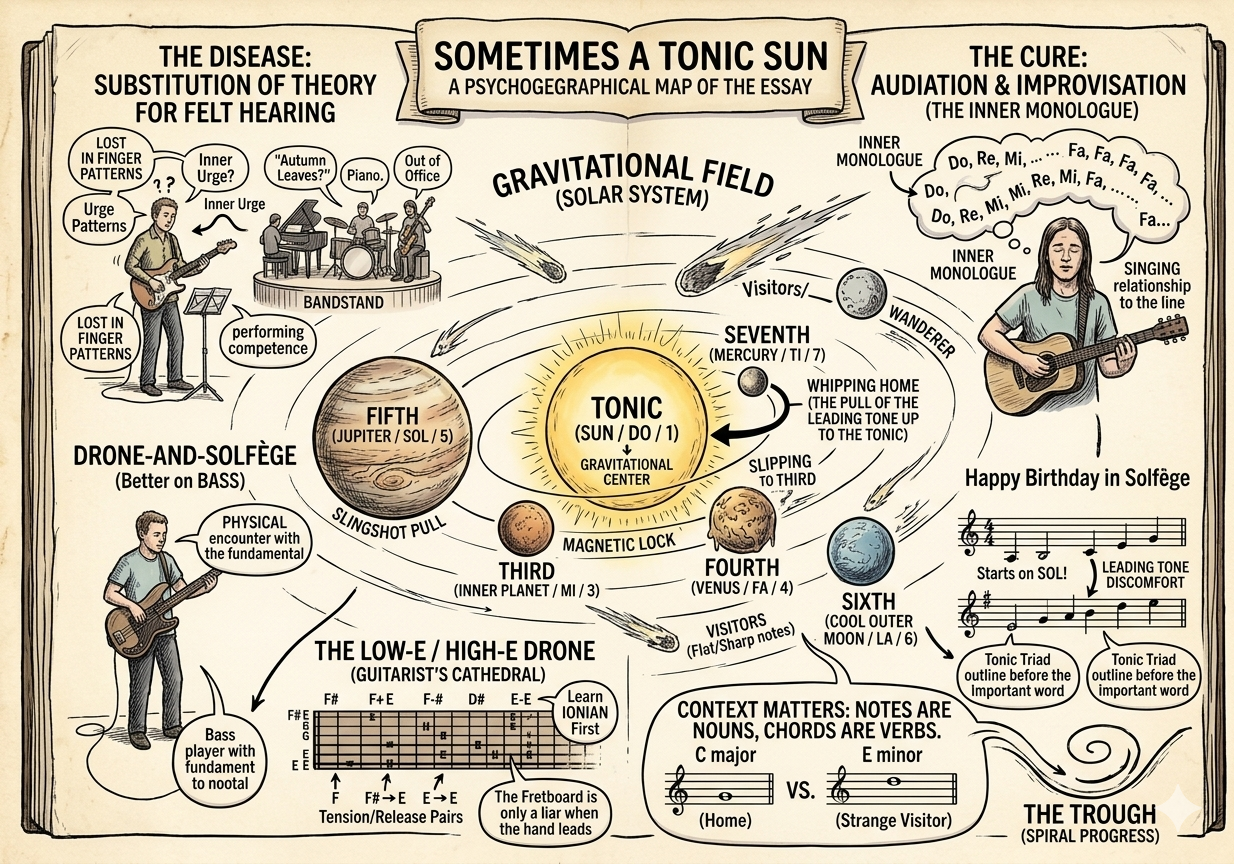
The tonic is the sun. It is the gravitational center of the entire system. Everything wants to fall back into it. Diatonic or chromatic, near or far, every other pitch in the key is in some kind of orbital relationship with the tonic, and you can feelthat relationship if you slow down enough to notice it. The leading tone leans forward like a runner before the gun. The fourth scale degree hangs slightly above the third like a held breath. The sixth wanders out toward the colder parts of the system. The second drifts between the third and the tonic, undecided, a moon caught between two planets. All of them are in conversation with the sun.
The fifth — the dominant — is the largest of the planets. Call it Jupiter. It has its own gravitational pull. It is the second strongest center of attraction in the system, and it is the reason a V chord feels like both a destination and a launching pad: stable enough to land on, unstable enough to want to slingshot back to the one. If the tonic is the sun, the fifth is the planet most likely to have moons of its own.
The third is the smaller inner planet whose job is alignment. When played alongside the root and the fifth, it doesn’t orbit so much as lock — the way one magnet snaps to another when you bring them close enough. The triad isn’t a stack of notes; it’s a magnetic field. The 1, the 3, and the 5 fall into a configuration that rests. That stillness is the bed on which everything else — melody, solo, lyric, line — will lie down.[6]
The remaining diatonic notes fill out the system. The seventh is Mercury — small, fast, in tight orbit, never able to escape the sun’s pull, always whipping back toward home. The fourth is Venus — hot, unstable, almost always slipping down to the third, gravitationally restless even when it appears to be sitting still. The sixth is one of the cooler outer planets, far enough from the sun to feel its independence, close enough to be drawn back when called. The second is the moon-like wanderer, sometimes pulled up to the third, sometimes down to the tonic, with an orbit eccentric enough that you can never quite predict which way it will go until it goes.
And the chromatic notes — the flat nines, the sharp elevens, the blue notes, the secondary leading tones — are comets. They pass through the system. They bend around the sun. They produce, in their passing, tremendous heat. And then they leave. They are not residents of the field; they are visitors, and the field knows it, and so do you when you hear them. A b9 over a dominant chord doesn’t want to stay. It is a comet, and the moment you give it a tail you also give it an exit.[7]
This is the map. It is the conceptual ground beneath every exercise that follows. When you do the work — when you sit with a drone, when you sing the leading tone and feel it pull toward home, when you find the tonic of a song you’ve been singing for thirty years — you are not learning facts about music. You are learning to feel a gravitational field you have been standing inside your entire life without knowing it was there.
Before the Menu: A Note on How This Actually Goes
Method books lie to you about progress. They lie not because their authors are dishonest but because the format requires it: a numbered sequence sells better than the truth.
The truth is that learning to hear is not linear. It is spiral. You will get to a certain point with audiation, and then — because of fatigue, or a long break, or a hard week, or the simple fact that the human ear is not a USB drive — the ability will seem to disappear. You will sit down to do an exercise you used to do well, and you will be worse at it than you were six months ago. You will think you have lost the thing.
You have not lost the thing. You have entered the trough. And if you keep showing up, the next time you encounter the exercise — through some combination of grace and dumb luck — you will find yourself a few steps further along than you were the last time you thought you understood it. You walk the same path, and you pull out whatever weeds have grown back since you last passed through, and you etch the path a little deeper where it used to be faint. That is the work. That is what it actually looks like. Nobody is going to tell you this in a method book, because “you will get worse before you get better, repeatedly, for the rest of your life” is a hard sell.
What follows, therefore, is a menu, not a syllabus. Ingredients to be deployed when needed. There is no order, except in one specific case I’ll flag when we get there. You can spend a week on one exercise. You can spend a year on another. You can lose them all and come back. The field will still be there. The sun does not move.
Exercise 1: Sing ‘Happy Birthday’ in Solfège, and Notice Where the Tune Actually Lives
Start here. I don’t care how advanced you are. Start here.
Sing the first phrase of “Happy Birthday” out loud. Wherever you are. I’ll wait.
Now do it again, but this time sing it in solfège. Do, re, mi, fa, sol, la, ti, do — the seven syllables you may or may not remember from grade school, plus the octave. Figure out which syllable each note of the melody corresponds to.
The most common mistake students make on this exercise is that they assume the song begins on do. It does not. “Happy Birthday” begins on sol — on the fifth, on the planet, not on the sun. The first “happy happy” you sing is sol sol, a held breath up in dominant territory, the song already in tension before it has even arrived anywhere. The song does not begin at home; it begins in the gravitational field with the sun on the other side of the room, pulling.
That alone is worth sitting with. Every reader of this essay has sung “Happy Birthday” hundreds of times. Almost none of you have noticed that the song does not start at home, and that fact is not a trivial observation — it’s the difference between thinking “the first thing must be the home thing” (the assumption of every novice) and understanding that the tonic isn’t where you start; it’s where you earn your way to.
Now keep going. Sol sol la sol — “happy birth-day to…” Listen to what the la does. It rises, briefly, above the fifth, and then it falls right back. The la is not yearning toward the tonic — the sun is too far away to feel from up there. The la is locally pulled back to the sol it just left. A planet briefly perturbed by a passing body, snapping back into orbit.
Then: do, ti — “to you.”
Stop there. Don’t finish the song yet. Just sit on that ti. The leading tone. Mercury, whipping toward the sun. The body of the song has just landed, for the very first time, on a pitch that physically cannot rest. Every cell in your body wants to resolve it. Try not resolving it. Sit there for ten seconds. Notice the discomfort. That discomfort is functional harmonyoperating on you in real time, without your permission, the way it has been operating on you your entire life.
Now resolve it. Sing the next phrase — sol sol la sol re do becomes its answer, the question reversed, the unfinished thought completed. That feeling you just had — of ah, finally — is the field doing what fields do. You didn’t have to know the word “cadence” to feel it. The cadence felt you first.
Then the song does something extraordinary, which is that it suddenly stops wandering and outlines the tonic triad in one heroic leap: sol — sol mi do, “hap-py birth-day dear —.” After two phrases of orbital drift, the song takes the express elevator to home, snapping into the magnetic lock of 1–3–5 right before the most important word in the song, which is the name of the person being sung to. This is the song musically saying this part matters; pay attention, and it makes that point by aligning the triad.[8]
Then the song does something else — the highest, most emotionally loaded note in the entire melody, the fa on the final “hap-” of “happy birthday to you.” That fa is the song’s emotional peak. It’s the only moment in “Happy Birthday” that reaches above the tonic before coming back down, and it’s the unstable fourth scale degree leaning hard on the third below it — Venus, hot and restless, slipping down to the third where it can rest. Almost nobody who has ever sung this song has consciously registered that this fa is doing what it’s doing. But everyone has felt it. That’s the entire point of the exercise. The fa was always doing the work. You just never had words for it.
Audiation makes the invisible audible. This song — the most banal, the most universal, the one everyone in the room can sing without a chart — contains in its thirty-second melody nearly every gravitational concept you will ever need to understand. The reason you couldn’t hear it before is not that the music was hidden. The reason is that nobody told you to listen.
Exercise 2: The Drone-and-Solfège (Better on Bass; Available to Everyone)
Sing a low but comfortable pitch. Whatever feels natural in your speaking range. Call that pitch do. You have just established the key you are in.
Find that same pitch on your instrument — the lowest available version of it. If you’re on bass and you sang a G, that’s the third fret of the fourth string.[9] Drone the note. Let it ring. Sing do against it and match your pitch to the instrument’s.
Then sing do–re–do. Drone still going. Then do–mi–do. Then do–fa–do, do–sol–do, do–la–do, do–ti–do, and finally do up to the octave do.
Then do the tension-and-release pairs: re–do, fa–mi, la–sol, ti–do. The four most important gravitational pulls in the diatonic system, isolated and rehearsed, until each one becomes a felt physical certainty.
Here is why this exercise lands harder on bass than on any other instrument: the bass is the instrument closest to the human chest. The frequencies are low enough to be physical events rather than pure auditory ones. When you drone a low G, you feel it in the wood, in your sternum, in the floor. Your voice is not just matching a pitch — it is locating itself inside the harmonic series of the instrument. Bassists who grow up doing this work end up with a relationship to the fundamental that guitarists usually have to fight years to develop, because the bass forces a physical encounter with the tonic that the guitar lets you intellectualize your way past.
The whole point of the exercise: the instrument is not the oracle. Your ear is the oracle. The instrument is just the place where the ear’s findings get confirmed in wood and steel. You sing first. The bass agrees, or it doesn’t, and if it doesn’t, you adjust the voice, not the bass.
Exercise 3: The Triad and the Voice (the Inside Job)
This is the deepest exercise in the menu. If you only do one thing on this list, do this one. If you only do it once a week, that’s enough.
Play a plain C major triad on a piano — root position, no inversion drama, just C–E–G ringing out. Hold the chord. Sing a C against it. Match the root.
Now here is the actual work: notice both sounds at once. Your voice and the chord. Make a judgment about how they relate. Are they aligned? Are they in tune with each other? Where is the friction, if any? This is not analysis. This is noticing.
Now sing a C# against the same C major triad.[10]
Don’t resolve it. Don’t run. Don’t “fix” the dissonance by sliding back down to C. Just sit there. Notice the beating of the sound waves — the actual physical pulsation produced by two pitches a half-step apart, fighting each other in the air between you and the piano. Notice what your throat wants to do. Your throat wants to drop a half-step. Don’t let it. Hold the C#. Make a judgment. Feel the effect.
Then walk it up: D against C major. D# against C major. E (now a chord tone — watch what happens; the pitch will disappear into the chord, lock into the field). F. F#. G. G# (against the same triad, every chromatic tone, all the way up to the C an octave above where you started). Make a judgment at every step. Feel each note’s specific relationship to the chord beneath it.
Here is the thing nobody tells you about this exercise: it is wholly an inside job. I cannot verify, from outside, whether you are hearing the C# as dissonant against the C. Only you can. And the entire industrial machinery of music education has slowly evolved to teach the things that can be externally verified — speed, accuracy, scale fluency, all the metrics that fit on a jury sheet — because those are the things that can be graded and certified and monetized.[11]
The unverifiable things — audiation, the felt sense of consonance and dissonance, the gravitational pull of one note against another — get neglected because there’s no rubric. There is no Berklee final exam for “did this student really hear the C# beating against the C.” But that is the actual work. The inside job is the discipline.
This exercise is structurally similar to meditation. You are sitting with something uncomfortable, refusing to fix it, and developing the capacity to notice your own internal state without intervention. The dissonance is the teacher. The desire to resolve it is the student. The practice is staying in the room.
Exercise 4: The Low-E / High-E Drone (Guitar-Specific; the One Place Order Matters)
Tune up. Strike your low E open and let it ring as a drone. Improvise on the high E string — single-line, melodic, slow — against that drone.
Begin in E Ionian. Major. Only the major scale. No fancy modes yet. The reason for this is the one place in the entire menu where I’m going to insist on an order: learn Ionian first. Ionian is the only mode in which every degree’s gravitational pull aligns with the listener’s lifetime of accumulated Western-tonal expectation. It is the default field. Learning Dorian or Mixolydian first is like learning a second language before you have a first — you have nothing to translate from. Once Ionian is in your body, the other modes become felt deviations from a known field, which is how the ear actually processes them anyway. Dorian doesn’t feel like Dorian for years; it feels like “major but the third is flat,” and eventually that gets replaced by the standalone feel of Dorian, but only after Ionian has done its work as the reference point. Build the floor before you decorate the room.
So: E drone. Improvise in E Ionian. Explore, specifically, the four tension-and-release pulls: re down to do (F# to E), fadown to mi (A to G#), la down to sol (C# to B), and ti up to do (D# to E). Stop on each of those resolutions and feel it land. Then keep going.
This exercise trains two things at once. It trains the ear, obviously — each pull becomes a felt event over the drone, every relationship audible against an unmoving root. But it also trains the hand. The fretboard, for all its sins, is a ruler: each fret is a discrete unit of pitch-distance, and when you do this exercise honestly — ear leading, hand following — you are teaching your fingers to judge intervals as physical distances. A whole step is not just a sound; it becomes two frets of string-length collapsing under your finger as the note resolves. The ear and the hand begin to say the same thing in two different languages.
This is, incidentally, the answer to The Guitar Is a Liar. The fretboard is only a liar when the hand leads and the ear follows. The fretboard isn’t lying when the ear is leading; in that configuration, it becomes a physical embodiment of interval. The instrument’s great pedagogical sin and its great pedagogical gift are the same property, viewed from different angles.
Once Ionian is solid — and “solid” here means you can sing the next note before you play it, reliably — then, and only then, move on. E Dorian. Then E Phrygian. Then Lydian. Then Mixolydian. Then Aeolian. Then Locrian. Each one against the same low E drone, so the deviation from the default field is audible. Then — a year or two later — melodic minor and its modes. Then harmonic minor. Build the cathedral one stone at a time.
Exercise 5: Find the Tonic of a Song You Love (the Hunt-and-Peck)
Pick a song you’ve been listening to lately. Doesn’t matter what. Pop, country, jazz, hip-hop, anything with pitched content. Put it on. Pick up your instrument.
Find the tonic.
That’s the exercise. Find the single pitch that sounds, to your ear, most like home for the song. Hunt and peck. Try a note. Listen. Does it feel like home, or does it feel like it wants to go somewhere else? Try another note. Try a third.
Almost every student I’ve put through this exercise discovers the same thing in the first ten minutes: the fifth masquerades as the tonic, and it is shockingly difficult to hear the difference between the two. The dominant has so much gravitational pull of its own that it can fool you into thinking it’s the center. It feels stable. It feels resolved. It isn’t. It’s the largest planet, not the sun, and the only way to tell the difference is to sit with the candidate pitch and ask: does this feel like a destination, or does this feel like a runway? The fifth is always a runway. You just have to learn to feel the takeoff.
And then — this is the moment that turns this exercise from a tool into a revelation — try this:
Find the tonic of a song in a major key. Hold the tonic pitch on your instrument while the song plays. Listen to how the pitch sits inside the music. It feels like home. It feels like rest. It disappears into the harmony.
Now find a song in a minor key that happens to use the same pitch as a relevant note — say, a song in E minor where you can hold a C against the music. Hold the C. The same pitch now sounds completely different. It doesn’t feel like home. It feels like a passing visitor. In some moments it may even feel like a wrong note.
You have just discovered, in your own hands, the deepest single fact in music: notes do not have fixed identities. They have functions. And function is contextual.[12] The same C pitch is a homecoming in C major and a strange visitor in E minor. The note is a noun that becomes a verb the moment it enters a sentence. The chord is the sentence. The key is the paragraph. The song is the essay. And a C in the wrong sentence is exactly as wrong as the word however dropped into the middle of a love letter.
A Note for Bassists
If you’ve been reading this essay as a bassist and feeling like the guitarist gets all the toys, stop. Look at the menu again.
The two best exercises on the list — the drone-and-solfège, and the triad-and-voice — are not bass exercises tacked on at the end of a guitar essay. They are foundational ear-training disciplines that happen to land most powerfully on bass, for reasons that have to do with the physics of low frequencies and the cultural conditions of bass-playing. The bass forces a physical relationship with the fundamental that the guitar lets you intellectualize. The bass-playing community has somehow inherited a belief that the bassist is the silent foundation, the locked-in groove machine, the player whose job is to disappear into the kick drum — and that belief has functioned, in practice, as permission to never develop a singingrelationship to the line being played. Bass culture has, without meaning to, taught generations of players that they don’t need to audiate, because the chord chart will tell them the root and the drummer will tell them the time.
This is a beautiful idea that has been weaponized into an excuse.
Root–fifth–octave is not bass playing. It is the bass-playing equivalent of a guitarist who only plays power chords — perfectly fine as a technique, useless as a vocabulary. The bassists I admire most — the ones who can take eight bars on one chord and say something — audiate every line before they play it. They sing the line first, in their head, sometimes out loud, and the instrument confirms. They are not pattern-runners. They are singers who happen to use a four-string.[13]
So the menu is, if anything, more for you than for the guitarist. Start with the drone. Start with the triad. Sing first. Let the bass be the verifier. The exercises in this essay are not afterthoughts to a guitar manifesto; they are the foundation, and you, of all readers, have been handed the deepest tools first.
Now go sing.
Coda
These days, I get disappointed when I get together with musicians who don’t want to improvise.
I want to have conversations. I want to talk about things — things played, things said in sound — that I’ve never said before. I want to make it up as I go along, and through some act of undeserved grace, I am no longer afraid of flubbing a note or a chord or even a whole song.
My favorite musical experiences now are the ones where we pick a key (or not), or a mode (or not), or a rhythm (or not), and we just go. We just make pitched (or not) sounds and try our best to make something that means something. To say something worthwhile. Sometimes — many times — we don’t.
But just as I don’t really know what I think about a particular subject until I start writing essays like this one, I don’t really know what I’m trying to say musically until I start hunting and pecking. If I find a good note, I’ll play it again. If the note doesn’t work, I’ll try another one (or not). And I don’t stop until I’ve said something that couldn’t be said any other way — something that only music, and usually only the particular moment, can communicate.
It’s a stretching, a reaching, with everything I’ve got, toward the sun.
Sometimes it’s a tonic sun, and sometimes it isn’t.
if this essay did something to you — cracked something open, confirmed a suspicion you'd had for years but never had words for, or simply made you feel less alone in your relationship with music — there's more where that came from. music as language is a publication about exactly what it sounds like: the idea that music isn't a metaphor for communication, it is communication, and that every person alive is already fluent in ways they haven't yet been told. new essays arrive when they're ready, which is to say: not on a schedule, but not randomly either — the way a good melody arrives. subscribe at michaelcelentana.substack.com and i'll meet you there.
[1]It is, statistically, almost always the guitarists. There is a sociological essay to be written about why the guitar attracts a particular kind of overconfident self-taught player at a rate disproportionate to other instruments, but it would require a longer footnote than this one, and possibly a different essay.
[2]I would like to say, in retrospect, that I understood the Lydian mode. What I had, more accurately, was a working familiarity with the Lydian scale — which is to the Lydian mode what owning a French dictionary is to speaking French.
[3]Reader, I cannot stress this enough: I had memorized substitute changes for a Joe Henderson composition that I could not have hummed to a five-year-old. The disease has a specific shape and the shape was me, that night, on that bandstand.
[4]The guitar’s great pedagogical sin is that the frets do the work the ear is supposed to do. Press here, get a pitch. The instrument hands you the relative-pitch information for free, which means you can spend years playing in tune without ever developing the internal capacity to hear what “in tune” actually means — a fact I explored in greater detail in “The Guitar Is a Liar.” The bass has its own version of this disease, but the bass’s symptoms are different and we’ll come to them later.
[5]The term “audiation” was coined by music education researcher Edwin Gordon, and like a lot of academic terms it has become so saturated with pedagogical jargon that it occasionally obscures the simple, almost embarrassing thing it actually means: hearing a sound in your head before you make it. Singers do this constantly. Composers do this constantly. Improvisers — the good ones — do this constantly. Most self-taught guitarists do not do it at all and have no idea they’re not doing it.
[6]Yes, the metaphor breaks down if you push it. The sun does not actually want anything. Gravity is not desire. A physicist reading this paragraph is, at this very moment, composing an email I will politely not open. But the felt experience of resolving a leading tone to a tonic is so close to the felt experience of watching something fall that I am going to keep the metaphor and ask the physicist for grace.
[7]There is a separate essay buried in the comet metaphor about the relationship between chromaticism and time — specifically, about how a chromatic note that overstays its welcome ceases to be a comet and becomes something else, which is either a modulation, a tonality shift, or a wrong note depending on how the player handles the next two seconds. I will not write that essay here. But I want you to know it exists, and that I am holding myself back.
[8]The fact that this happens right before the person’s name is not, of course, an accident. The song was structured by whoever it was structured by (the Hill sisters, allegedly) to do exactly this work: to align the harmonic apparatus right when the lyrical apparatus reaches its most personal point. You sing the person’s name on the most musically resolved moment of the entire melody. That’s songwriting. That’s a hundred-year-old piece of folk pedagogy hiding in a song you sing at children’s parties.
[9]Four strings. The four-string bass contains every note any human being has ever needed, and the proliferation of additional strings is a symptom of the same disease that produces the eight-string djent guitar, which is the belief that range is a substitute for ideas. I am aware that this opinion is contested. I am holding it anyway.
[10]If you don’t have a piano, a sampled triad on your phone will work fine. If you don’t have a phone, congratulations, and you may use a tuning fork and your imagination.
[11]This is not a conspiracy theory; it’s an institutional drift. When the only outputs an institution can credential are the ones it can measure, the institution gradually — over decades, through nobody’s individual fault — stops teaching the unmeasurable ones. The result is a generation of technically excellent musicians who can read anything, play anything, sight-transpose anything, and cannot tell you what the song they just played was about.
[12]Long-time readers of Music as Language will recognize that what you have just discovered in your own hands is the central thesis of the structural essay, arriving in tactile form, without any theoretical scaffolding. The note is a word. The chord is the sentence. The key is the paragraph. The song is the essay. And if you have ever wondered why the same chord progression can mean radically different things in different songs, the answer is contained inside the discovery you just made with the C and the E minor chord: function is contextual, all the way down.
[13]My deepest musical influence across all instruments is a drummer. Brian Blade. He sings every line he plays — sometimes audibly, sometimes only in his face — and the result is a kit that speaks. I have spent years trying to play guitar the way Brian Blade plays drums. I will spend the rest of my life trying. Bassists who watch him closely tend to come away changed.