Perpetual Motion
On the metronome, the fist, and the only measurement that ever mattered
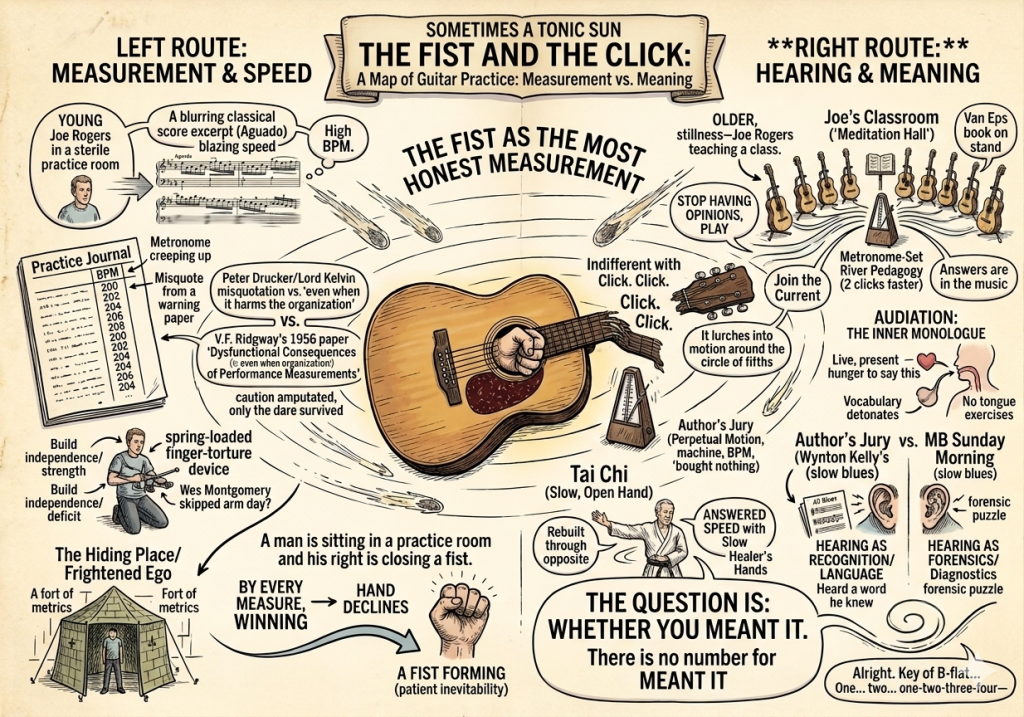
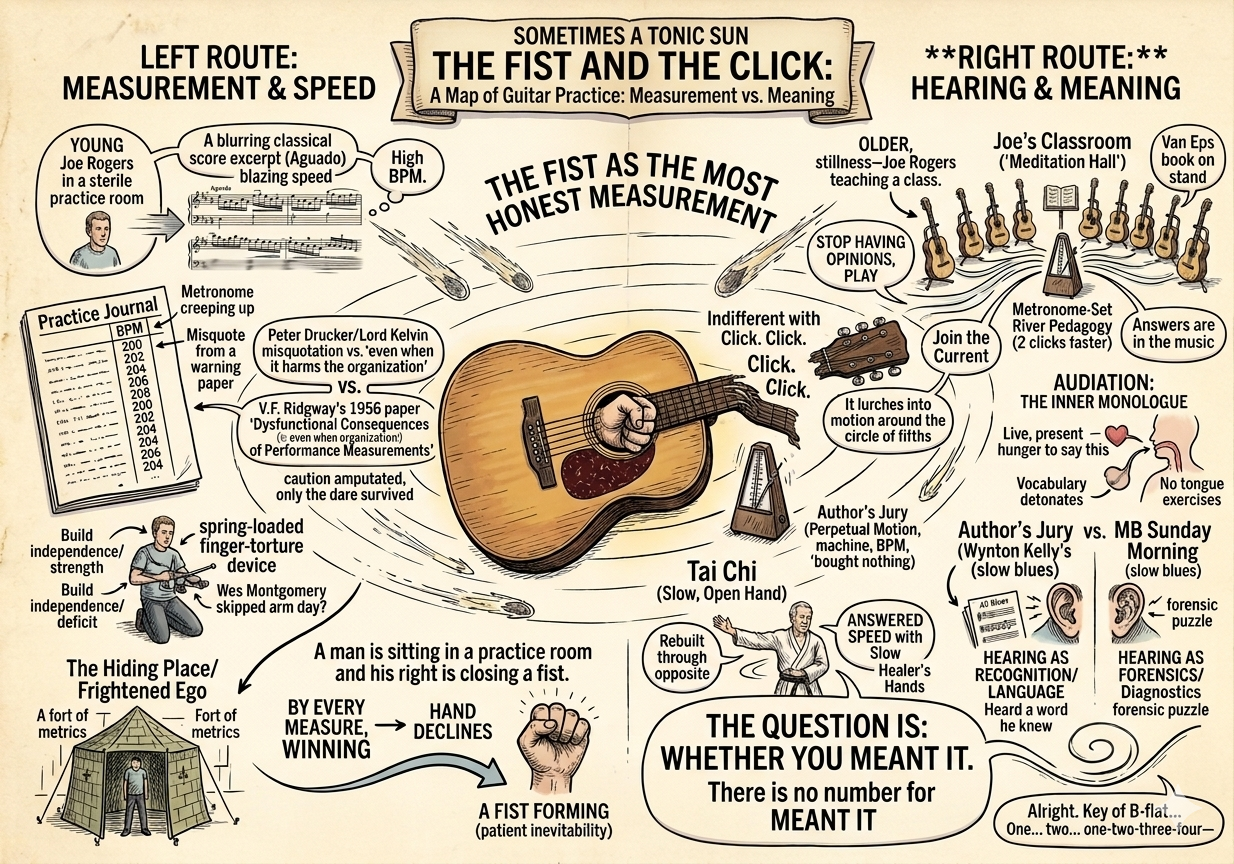
A man is sitting in a practice room and his right hand is closing into a fist.
He doesn't want it to. This is the part worth understanding before anything else: he is not making a fist, the way you make a fist when you are angry or cold or about to knock on a door. The fist is being made of him. The fingers — the four fingers that a moment ago were articulating a passage of Dionisio Aguado at a tempo somewhere between blazing and surely that is mechanically impossible — are curling inward of their own accord, slowly, with the patient inevitability of a time-lapse flower running backward, and there is nothing the rest of him can do about it. He is a world-class classical guitarist. He is, by every available measure, winning.And his hand is quietly, firmly, declining to participate any further.
I want you to sit in that room with him for a second, because I think the metronome is still going. I think — though he never told me this part, and I am filling it in, because it is the kind of detail that is true whether or not it happened — I think the little arm is still ticking away on the music stand, indifferent, keeping a perfect time that his body has just resigned from. Click. Click. Click. The most honest sound in the room. It does not know anything has gone wrong. It cannot know. Knowing was never its job. Its job was the one thing it does, which is to be right about the tempo, and it is, it remains exactly right about the tempo, all the way down, while the man it was right at loses the use of his hand.
The man's name is Joe Rogers, and he is still, as I write this, teaching guitar at the Berklee College of Music, which is where I met him, some years after the afternoon his hand decided it was done. I did not know about the hand then. You wouldn't have. By the time he got to me he had the unhurried stillness of someone who has already had his argument with the universe and lost it in the only way that turns out to be winning, and he carried it lightly, the way the genuinely formidable people always seem to.
What the injury cost him, and what he did with the bill once it came due, is the end of this essay, so I'm going to make you wait for it the way he made all of us wait for everything — which is to say without apology, and on the theory that you'll understand it better for having earned the distance. For now it's enough to know that the classical career did not survive. You cannot play Aguado, or anything, with a hand that curls shut at speed.
So back up, because I've skipped the part that makes the rest of this necessary. Before the fist, before me, before whatever it is he became — Joe was, in the parlance of the world he came up in, fast. Not fast the way you or I might mean it. Fast in the specific, slightly deranged sense the word takes on online, in the comment sections beneath videos of seventeen-year-olds playing Paganini caprices on seven-string guitars: fast in the holy-shit-no-fucking-way-that's-even-possible sense, the tempo as a feat of strength, the BPM as a dare thrown down and answered. He could play the Aguado pieces at speeds that, described to someone who doesn't play, sound less like music than like a parlor trick, or a symptom. And here is the part I need you to hold onto for the next several pages, because the whole argument pivots on it: it worked. The dare was met. Whatever number you wanted to write down — and someone always wants to write down a number — Joe could hit it. By every available measure, he had won.
And then his hand closed into a fist, and it turned out there had been a measure nobody was keeping.
Here is the sentence that put Joe's hand in that fist. You have heard it. You have possibly said it. I have said it, which is part of why I can recognize it at distance now, the way you can always spot your own bad habits fastest in other people:
What gets measured gets improved.
It comes in a few translations — what gets measured gets managed, what gets tracked improves, you can't improve what you don't measure — but they all carry the same cargo, and in a guitar player's hands the cargo gets unpacked into something very specific and very seductive. It becomes the metronome creeping up two clicks a day. It becomes the practice journal with the little BPM column. It becomes the app that turns your scales into a video game with a streak you are afraid to break. It becomes the spring-loaded finger-torture device sold at the counter of every non-discerning guitar shop in America, the one that promises to build "independence" and "strength" as though the thing standing between you and music were a grip-strength deficit, as though Wes Montgomery were just a guy who skipped arm day. It becomes, in its terminal form, a seventeen-year-old playing a Paganini caprice eight clicks faster than last month and genuinely believing — because every available measure agrees with him — that he is eight clicks closer to saying something.
The whole edifice rests on that sentence. So it's worth knowing where the sentence came from.
It came from nowhere. I mean that almost literally. The quote is most often pinned on Peter Drucker, the patron saint of management consulting, and the Drucker Institute — an organization with no conceivable motive to disown its own founder's greatest hits — says flatly that he never said it. The trail, such as it is, leads back to a 1956 paper by a man named V. F. Ridgway, with the genuinely thrilling title "Dysfunctional Consequences of Performance Measurements," and here is where it gets good, because Ridgway's paper is not an endorsement. It is a warning. It is a careful, footnoted, mid-century-academic plea to be more careful with quantitative measures, on the grounds that people who fall in love with the readout tend to stop noticing the thing the readout was supposed to be standing in for. The mantra of the measurement cult is a misquotation of a paper against the measurement cult. Somewhere along the way the caution got amputated and only the dare survived.
And even the dare, in its fuller forms, can't keep its own story straight. One widely circulated "complete" version runs: what gets measured gets managed — even when it's pointless to measure and manage it, and even when doing so harms the purpose of the organization. That is the actual sentence. That is the thing people cross-stitch onto the throw pillows of their ambition. It contains, built right into it, the confession that it will lead you off a cliff while reading you your altitude in a calm and reassuring voice.
The last detail is my favorite, and I want to give it to you slowly. Nobody can find the source. Scholars have tried. The candidates run from Drucker to Lord Kelvin to a sixteenth-century mathematician, and the most honest investigators eventually throw up their hands and admit that the origin of the phrase cannot now be determined — which is to say, in the phrase's own native idiom, that it cannot be measured. The quote insisting everything important can be measured is itself a thing that cannot be measured. It floated up out of the collective managerial subconscious, untraceable, attributed to whoever sounded most authoritative that decade, and it has been managing us ever since without ever once submitting to management.
I am dwelling on a piece of business-school folklore in an essay about guitar practice, and I want to be clear that this is not a detour. This is the whole thing. Because at some point — and I would genuinely like to know the day, I would like to find the meeting and read the minutes — somebody took a warning written about the assembly line and the sales quota and the org chart, stripped it of its warning, and walked it into the practice room. Somebody decided that the logic of the factory floor applied to the cultivation of an art. Somebody let the efficiency consultants in. And we have been practicing as though music were a thing you manufacture ever since — as though, if you just hit your numbers, meaning would come off the end of the line like a finished sedan.
It won't. There is no number for meant it. There has never been a number for meant it. And the cruelest part — the part Joe's hand was trying to tell him, in the only language the body has — is that you can hit every number on the sheet, every single one, all the way up to holy-shit-no-fucking-way, and arrive at the top with nothing whatsoever to say.
So let me take you into Joe's classroom, because the answer to all of this was in there the whole time, and it did not look like an answer. It looked like a mess.
Picture a dozen guitarists in a room. Their instruments are in twelve different states of almost-in-tune, which means the room itself is in a key that does not exist and has never existed, a sort of microtonal weather system that shifts every time somebody bumps a tuning peg. There is a book on each stand — something by George Van Eps, maybe, or Joe Viola, dense with chord forms or single-line studies — and there is a metronome, and the metronome is set, as it is always set, approximately two clicks faster than anyone in the room can comfortably manage. This is not an accident. I came to understand, eventually, that the two clicks were the entire pedagogy.
Joe would look at the book, and look at us, and say almost nothing. What he said was logistical. Alright. Key of B-flat. Click's on the two and the four. And then, in a voice with no drama in it whatsoever, the voice of a man reading a grocery list, he would count us in — one... two... one-two-three-four — and twelve guitars in twelve adjacent keys would lurch into motion around the circle of fifths, and we would go.
That was the class. That was, frequently, the whole class. There was no time to ask what the passage meant. There was no time to ask anything, which I did not understand at first was the point and not the problem. You could not stop to protest that you weren't ready, because the click did not care that you weren't ready, the click had somewhere to be, and the only way to participate in the room was to stop having opinions about your readiness and play the next thing. If you fell off, you found the nearest handhold — a root, a downbeat, the top of the next bar — and you climbed back on. The circle of fifths does not wait. It comes back around to B-flat whether or not you were there for it the first time.
I have spent a long time trying to describe what that room actually was, and the closest I can get is this: it was a meditation hall that happened to be full of guitars. Not "meditative." Not relaxing — God, no, it was terrifying. But structurally, mechanically, it was doing the exact thing a meditation practice does, which is to install a current too steady to argue with and then invite you, relentlessly, to stop arguing and join it. The metronome was not there to measure us. I cannot stress this enough, because it is the hinge the whole essay turns on. The metronome that broke Joe and the metronome in that classroom were the same machine doing opposite jobs. In Joe's practice room, decades earlier, the click had been a target — a number to defeat, a verdict to earn, the dare from the comment section made mechanical and personal. In Joe's classroom it was a river. You don't defeat a river. You don't earn it. You get in.
And when you got in — this is the thing I could not have told you then and can barely tell you now — the answers were already there. Joe used to say exactly that, in his flat un-mystical way, whenever somebody surfaced from the music long enough to ask a question. The answers are in the music. Not in his commentary. Not in the book's preface. Not in the BPM. In the music, which you could only hear once you'd stopped standing outside it taking measurements and gotten in, up to your neck, in the cold moving water of an actual tempo with eleven other people depending on you to keep moving.
I want to tell you about the Sunday morning I found out I couldn't speak.
But first I have to tell you about the jury, because the two things were happening in the same few weeks, in the same building, and the proximity is the entire point. A jury, at a conservatory, is exactly what it sounds like: you go into a room and a panel of faculty sits in judgment of your playing while making small marks on a form. The thing I was preparing for mine was an excerpt from a piece called — and I promise you I am not inventing this for the convenience of the metaphor — Perpetual Motion. I had been ratcheting it up for weeks, two clicks at a time, the practice journal, the BPM column, the whole apparatus, and I had gotten it to the speed at which it finally, gratifyingly, began to sound like its own title: an unbroken stream of sixteenth notes, motion without rest, a small machine I had built out of my own hands and could now switch on for a panel of judges. I felt, walking around campus that month, that this bought me something. A kind of credit. A standing.
Reader, it bought me nothing. It bought me the right to operate one machine.
The Sunday morning happened like this. I had been pestering a friend — call him MB, a pianist, the owner of the best pair of ears I have ever personally stood next to, and I mean that with full knowledge of who I have since stood next to, because MB went on from Berklee to the kind of career that makes him quietly famous in the rooms where that means anything, and the ears were always the reason — I had been pestering MB for weeks to sit down and learn some transcriptions with me. We finally found a free Sunday and a free practice room and settled on Wynton Kelly's solo from All Blues, off Kind of Blue. I want to be precise about the difficulty here, because it matters: that solo is not hard. It is a medium-slow blues in a comfortable key, and it sits, tempo-wise, in a different zip code from Perpetual Motion — it is, by every number I had spent the semester worshiping, easier. Slower. Fewer notes per second. I figured I'd eat it for breakfast.
We dropped the needle and listened to the first phrase, once. MB played it back. Immediately. Not approximately — exactly, the touch and the timing and the little human lean of it, and then he shrugged and said, "Oh, it's one of these thingies," the way you might identify a phrase your grandmother always used, a thing so worn into the language that it no longer requires thought, barely requires a name. One of these thingies. He wasn't reading it off the air. He was recognizing it.
And I sat there with my jury-ready hands and could not find it. I want to render this honestly, because the inside of that failure is the whole essay. I wasn't hearing music. I was running diagnostics. What key are we in. What are these scale degrees. Is that a flat third or am I— wait, what's the tempo, can we— that's not a line you'd even play on guitar — (it was; it was completely playable on guitar; I have played it on guitar many times since, easily, because the problem was never my hands) — and the harder I parsed, the further the phrase retreated, the way a word you're trying too hard to remember hides behind the effort of remembering it. MB, being kind, being encouraging, said the worst possible thing, which was: "C'mon, man. You can play this bit."
I couldn't. That's the truth of it. The bit was easy and I could not play it, and a hundred yards away was a room where I could play Perpetual Motion at a tempo that would make a stranger's eyebrows climb, and both of these things were true about me at the same time, and the second one had somehow convinced me I didn't need to worry about the first.
Here is what I understand now that I could not have told you then. I had spent the semester doing calisthenicsand calling it learning a language. I had built, through measurable, trackable, jury-pleasing effort, a magnificent set of muscles for saying nothing. MB had spent his time listening — which does not show up in any BPM column, which cannot be ratcheted, which a jury can barely grade — and he had accumulated, phrase by phrase, an actual vocabulary. When the first bar of All Blues went by, he heard a word he already knew. I heard a forensic puzzle. He was a man recognizing a sentence in his mother tongue. I was a tourist with excellent grip strength and a phrasebook I'd never opened.
Nobody learns to talk by doing tongue exercises. I want to put that as plainly as I can, because the entire industry of guitar practice is organized around the opposite assumption. No child has ever acquired a language by isolating muscle groups, by drilling phonemes up a metronome, by practicing the physical act of articulationin the absence of anything to say. Children learn the word for the thing they want. Their vocabulary detonates outward from need — from the live, present, unmeasurable hunger to say this, now, to someone. And the phrases they reach for and fail to find are precisely the ones that get learned next, because the failure itself is the lesson, the gap announcing exactly what's missing. That is how a human acquires a language. It is, not coincidentally, how MB had acquired his. And it is the precise opposite of what I was doing to Perpetual Motion, which was the musical equivalent of a man alone in a room getting world-class at moving his tongue.
Now. I have spent several pages telling you to throw out the metronome-as-master and the BPM column and the whole apparatus of measurement, and to practice instead by listening for what wants to be played — what's speaking loudest, what the music is reaching for, the live and present hunger to say this. And I can feel, from here, the relief that proposal generates in a certain kind of player, because it sounds like permission. It sounds like I've just told you that you don't have to do the boring thing anymore. Follow your ear! Play what calls to you! Throw away the schedule and trust the muse!
I need to take that relief back, or at least complicate it past the point of comfort, because it is a trap, and it is the specific trap I fell into in the practice room with Perpetual Motion, and I'd be a fraud if I let you walk into it grinning.
Here is the problem. When you sit down and ask the open question — what's speaking loudest right now — you are assuming you can tell the difference between two voices that sound, to the untrained ear, identical. One of them is the music's voice: the genuine pull toward the phrase you can't yet play, the sound you can hear in your head but not yet in your hands, the thing that is missing and wants in. The other is your own voice wearing the music's clothes. And your own voice, nine times out of ten, is calling you toward the thing you already do well.Because that thing feels good. It rewards you on contact. It hands you, instantly and reliably, the small warm hit of competence — ahh, yes, I can do this — and the mind, left to wander, does not wander into the void. That's the part the romantics get wrong about following your muse. An untended attention doesn't drift into noise. It drifts home. It pads back to the comfortable lick, the safe key, the familiar shape of your own hands, and it calls this inspiration the whole way there.
Perpetual Motion was that. I want to be clear-eyed about it now, with the distance. I did not choose to spend a semester ratcheting a perpetual-motion machine up to performance tempo because the music demanded it of me. I chose it because I was good at the kind of thing it was, because every session delivered the measurable hit — two clicks faster, look at that, progress — and because down the hall was a much harder and much quieter task, which was learning to actually hear, and hearing offered no hits at all. It offered only the daily news that I couldn't do it yet. So I did the thing that flattered me and called it practice, and I told myself the metronome was keeping me honest when in fact the metronome was the precise instrument of my dishonesty. It let me feel like I was working while I avoided the only work that would have mattered. Measurement wasn't the discipline. Measurement was the hiding place.
This is the cruelest mechanism in the whole business, and I want to name it as plainly as I can: the measurable thing is almost always the comfortable thing. That is not a coincidence. The reason a thing is easy to measure is usually that it's been reduced to a quantity — speed, accuracy, reps, streak — and quantities are exactly what your ego knows how to win at. You cannot put a number on did I say something true today, but you can put a number on how fast can I run the perpetual-motion machine, and so the number is where the frightened part of you goes to live. It builds a little fortress out of metrics and defends it to the death, and the fortress has only one purpose, which is to keep you from ever having to stand in the open and find out whether you have anything to say.
So the discipline I'm actually proposing is not follow what feels good. It is close to the opposite. It is: learn to tell the music's voice from your own, and then — this is the hard part, this is the part that takes years and that nobody can do for you — follow the one that doesn't flatter you. Walk toward the All Blues you can't play, not the Perpetual Motion you can. The signal you want is not the warm hit of competence. It's the cooler, more uncomfortable sensation of I can hear something I can't yet do — the gap, the missing word, the phrase retreating behind the effort of reaching for it. That discomfort is not the absence of the lesson. That discomfort isthe lesson, announcing its own location. It is the music telling you exactly where it lives, which is always, always one step past the edge of what you can already measure about yourself.
Let me give you the other side of it, the comic side, because I learned this lesson twice — once by being the guy who couldn't play All Blues, and once by watching someone else refuse to learn it at all.
This was a guitar ensemble class, also Joe's. We were playing an arrangement of "Synchronicity II," by the Police, which if you don't know it is a song built on a guitar figure that does something rhythmically slippery — dotted sixteenths, syncopations that don't sit where your hand wants them to sit, the kind of part that is not fastbut is genuinely, fundamentally tricky, in that it asks you to feel the time in a way you have to actually learn rather than muscle through. Which is to say it was a part you could not shred your way out of. And there was, in this class, a guy — every guitar program has exactly one, often several, and I will call him Shred, because to name him further would be unkind and because the name is doing all the work anyway — who had clearly arrived hoping the semester would furnish him an occasion to demonstrate his hands. You know the type. You have heard him through a practice-room door. He could play very fast, and he wanted, very badly, for this to be relevant.
"Synchronicity II" was not giving it to him. He was tangling on the rhythm, the dotted-sixteenth business, the part refusing to resolve into the kind of thing his hands already knew how to do, and you could see it frustrating him — not because it was beyond his ability, it absolutely was not, but because it required him to slow down and learn to feel something, which is a different skill entirely from going fast, and arguably its opposite. So he did what the measured mind does when the unmeasurable task arrives. He looked for the exit.
He raised his hand and asked Joe, more or less, whether there was a way to play the part without the written rhythm — without getting into "the whole dotted-sixteenth thing" — some simplified version, some workaround, some path through that didn't require him to actually do the hard quiet work of internalizing a feel he didn't yet have. He was asking, in the oldest and most human phrasing there is, the question I had once asked the universe in my own way and that Joe had once asked it in his: is there a way to do this without doing this?
Joe heard him out. Joe always heard you out; that was part of it, the full and patient attention, the refusal to rush to the answer, which made what came next land with no cruelty in it at all, only a kind of granite calm. He paused a beat. And then he said — and I have thought about this for twenty-some years, this may be the most complete piece of teaching I have ever personally witnessed, four syllables and a count-off —
"No."
A breath.
"One… two… one-two-three-four—"
And off we went, twelve guitars into "Synchronicity II," Shred included, the question dispatched so completely it left no residue, no debate, no opening for a follow-up, because there was nothing to follow up. No was the entire seminar. No was the whole of music pedagogy compressed to its atom. There is no way to do this without doing this. There is no version of the phrase that arrives without the work of learning to feel the phrase. The answer was, as it always was with Joe, in the music — and the answer, that day, was no, and then the count, which was Joe's way of saying that the door he'd just closed was the only door, and that it was, in fact, already open, and that all Shred had to do was the one thing he was determined not to do, which was walk through it at the actual tempo with everybody else.
Shred never did get that part down. At least, not in that class.
I told you I'd make you wait for the end of Joe's story, and you've earned the distance now, so here it is.
When the injury came — when the hand began closing into the fist at the top of the Aguado, at the tempo somewhere past holy-shit-no-fucking-way — it did not, at first, present itself as a teaching. It presented itself as a catastrophe. A world-class classical guitarist does not get to keep being a world-class classical guitarist with a hand that curls shut at speed, and so the thing Joe had spent his life measuring his way toward was simply, abruptly, over. The numbers had all said yes, right up to the morning they became irrelevant, and then there were no numbers at all, only a hand that would not open and a silence where a career had been.
And here is what he did with it, which is the reason I have spent this entire essay walking you toward a man you'd never heard of. He took up Tai Chi. Of all the things — Tai Chi, a martial art whose entire physical vocabulary is the slow, open, unhurried hand, the hand that flows and does not grip, the precise and total opposite of the fist that had ended him. He went, with what I can only imagine was enormous patience, all the way down to the bottom of his own body and rebuilt it through its opposite, and he got good enough at the opposite to earn a black belt in it, which means the discipline that broke him at fast he answered with a discipline that has no fast in it at all. And somewhere in those years the question quietly changed its shape. It stopped being how fast can the hand move. It became how much can the hand notice. And the hand that had closed into a fist became, over time — this is his word, it is on his faculty page, you can read it today — the hands of a healer, a pair of hands whose whole job is now to open other people up. Including, for what it's worth, me.
I am aware that this is almost unbearably neat, and I told you near the beginning that when a life rhymes this cleanly the only honest thing to do is point at it rather than pretend you arranged it. I didn't arrange it. Joe didn't arrange it either. The body arranged it — the body, which cannot be lied to and cannot be sped up past its own truth and will, if you ignore it long enough in pursuit of a number, simply close its hand and refuse. The fist was not Joe's failure. The fist was the most honest measurement anyone ever took of him. It measured the one thing the metronome couldn't: the gap between how fast he could play and whether any of that speed had ever been the point.
So here is what I've come to believe, standing on the far side of a jury I aced and a Sunday morning I failed and twenty years of teaching my own students in rooms that I try, and mostly fail, to make a little more like Joe's. The thing worth getting good at is not measurable, and the measurable things are mostly hiding places, and the whole apparatus — the BPM column, the streak, the spring-loaded torture device, the perpetual-motion machine running flawlessly in an empty room — is an elaborate and sincere and almost universal way of avoiding the one question that actually matters, which has never been how fast and has never been how clean and has never, not once in the history of anyone moving anyone else with sound, been a question a number could answer.
The question is whether you meant it.
There is no metronome for that. There never was. Joe knew it, finally, the hard way, with a hand that wouldn't open — and then he spent the rest of his life teaching it the only way it can be taught, which is to say almost nothing, and set a click two notches too fast, and trust that the answer was already in the music, waiting for you to stop counting long enough to hear it.
Alright. Key of B-flat. The click's on the two and the four.
One… two… one-two-three-four—