25. March 2026
The Loafer
On Improvisation, Technicians, and the Shoe That Flew Off Brian Blade’s Foot
There’s a particular sound that anyone who has ever played electric guitar in front of other human beings will recognize immediately, the way you’d recognize the sound of your mother’s voice or the ignition of a car you once owned and will never fully stop associating with a specific period of your life. It is the sound of a 1/4-inch guitar cable being inserted into an input jack — the other end of which is plugged into an amplifier set several ticks past “10” — while the jack itself seems to move around at precisely the moment you need it to stay put. It is a harsh, percussive crackle, the auditory equivalent of someone dragging a fork across a ceramic plate, and it is the sound that greeted me before I could even see the stage at a venue in Asbury Park, New Jersey, where I had arrived in a state of unironic delight to see Evan Dando and the Lemonheads.[1]
My first thought, hearing that crackle: Man, who did they hire as guitar tech? This guy sucks. My second thought, upon rounding the corner and gaining a sightline to the stage: Oh no.
It was Dando himself performing this assault on the audience’s eardrums. And the assault, it turned out, was only just beginning.
Within the first verse of the first song it became apparent why Evan had been having such a time with that pesky input jack. He launched into “Ceiling Fan in My Spoon” — and “launched” is the appropriate word, as he nearly fell over, and would have found himself off the stage and in the front row if not for a strangely stout microphone stand that caught him like a bouncer catching a trust-fund kid at last call. With his mouth directly on the microphone, he slurred his way through what I think was the first verse, managing just one clearly pronounced chorus before he abruptly stopped the song to berate someone — the audience? The sound guy? The bartender who should have cut him off last Tuesday? — and it became clear, with the sudden and deflating certainty of a balloon encountering a thumbtack, that this was going to be a long night.
The band — and here I have to credit the band, who played with the grim professionalism of session musicians accompanying a man through a hostage situation — managed to slog their way through the setlist in spite of Dando’s obvious Herculean pre-gig intake of alcohol. Not one lyric could be clearly heard. He was on autopilot, playing with what I can only describe as near-disdain for the music he himself wrote.
And this is where it gets interesting. Or, more accurately, this is where it stopped being a mere bad-show anecdote and started being something I couldn’t stop thinking about.
* * *
I. The Recitation Problem
Because here’s the thing about that Dando show that nagged at me for weeks afterward, the thing I kept circling back to while driving, while teaching, while trying to fall asleep: even the solos were performed note-for-note.
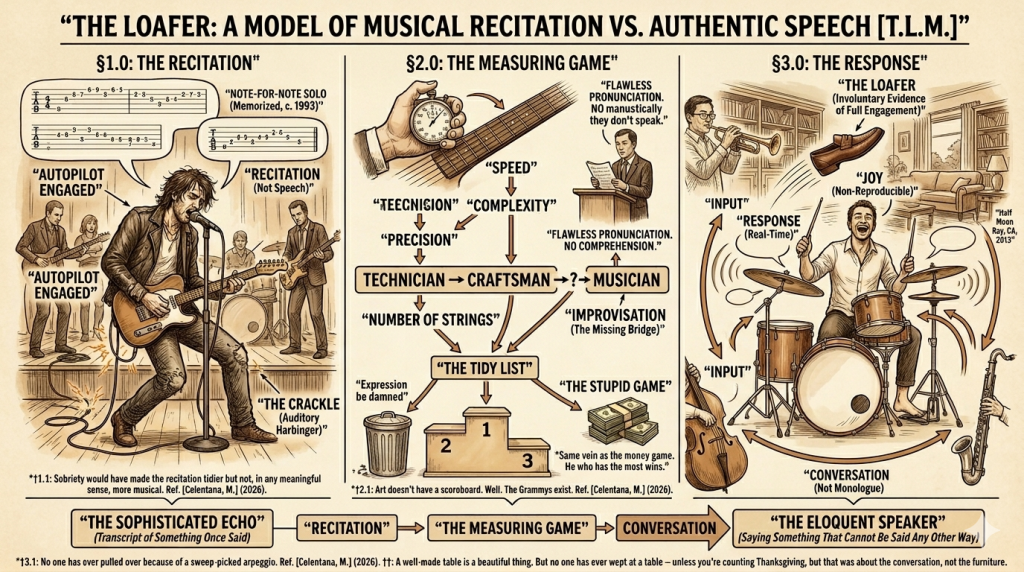
Drunk — impressively, almost heroically drunk — and he was still playing the solos exactly as they appear on the recordings. Not approximately. Not in the same neighborhood. Exactly. Which means, of course, that the solos were always memorized. The alcohol didn’t change what he was playing; it just made the recitation sloppy. Sobriety would have made it tidier but not, in any meaningful sense, more musical.
I want to pause here and acknowledge that this is a dangerous word — “musical” — and that I’m about to use it in a way that will make some people uncomfortable. Possibly angry. I’m going to argue that what I witnessed that night in Asbury Park was not music. It was a show. It was the spectacle of a rock star on stage, out of his gourd, performing a pantomime of the creative act.[2] The songs were about his life thirty years ago, and he treated them as if he was trying to forget he was ever the person who wrote them. These were not living utterances; they were transcripts. He was reading aloud from the record of something he once said, in the way that a person might recite a wedding toast they gave in 1997 — the words technically still theirs, but the breath behind them long gone.
And this distinction — between recitation and speech, between reproduction and expression, between performing a thing and actually saying something — is, I’ve come to believe, the single most important distinction in all of music. It is the line between a technician and a musician. And the skill that separates them, the capacity without which one remains permanently on the technician side of that line regardless of how many hours one has logged in the practice room, is improvisation.
* * *
II. The Claim (Stated with Full Awareness of Its Audacity)
Let me say it plainly, because I think plain statements deserve their moment before the qualifications arrive:[3]
The ability to improvise is the single most important skill a musician can possess. Its absence renders a person, however technically brilliant, essentially non-musical.
When I say “improvise,” I don’t mean — or don’t only mean — the jazz-lineage practice of soloing over chord changes, though that is certainly one expression of it. I mean something broader and, I think, more fundamental: the ability to respond in real time to what is happening musically. To listen and adjust. To make a choice in the moment based on what the music needs right now, not what you decided three weeks ago in your practice room it would need. This includes a rhythm guitarist adjusting their comping to what the vocalist is doing. A bassist choosing to leave space where they’d normally fill. A drummer sensing that the bridge needs to breathe and pulling back to ride cymbal when every instinct says crash. It is, in a word, conversation.
And if music is a language — which is not a metaphor I’m employing but a literal claim I’m making[4] — then improvisation is conversation, and technique without improvisation is recitation. It is a human being standing at a podium, reading a speech they memorized phonetically in a language they do not speak. The pronunciation may be flawless. The cadence may be convincing. But they are not saying anything, because they don’t know what the words mean, and if you asked them a question they could not answer it.
* * *
III. The Measuring Game (A Confession)
I should tell you, before I go any further, that I know this territory from the inside. Not as an observer. As a resident.
There was a period — years, actually, the better part of a decade — when I allowed myself to be taken into a particular camp of musicians and listeners. The camp of people who measure. They measure the speed, the complexity, the precision, the number of key changes, the number of strings on the guitar you can handle, even.[5] In short: anything that can be measured, they measure, and then they make a tidy list of who sits at the top and who sits at the bottom, and then they argue about the list with a fervor that would embarrass Talmudic scholars.
I played this game. I played it with total commitment. I practiced sweep-picked arpeggios until my fingers bled in that non-metaphorical way that only guitarists and rock climbers understand. I measured myself against other players on the metrics the game provided — speed, accuracy, complexity, range — and I either felt good about myself or terrible about myself depending on the results, which is how you know you’re playing a game rather than making art: art doesn’t have a scoreboard.[6]
It was, I came to realize — at the point of maximal frustration, the point where the dream of being a musician had been almost entirely replaced by the dream of being the fastest, the most technically proficient, the most impressive — an unbelievably stupid game. It is in the same vein as the money game, wherein he who has the most wins. Except in music, it’s she who plays the most notes wins, expression be damned. Who cares if you’re explaining what it feels like to be alive at this particular moment in time when you can’t play a D minor arpeggio at 160 beats per minute?
The realization didn’t arrive as a thunderclap. It arrived as a depression. A slow, heavy dawning, like watching the sun come up on a day you know is going to be terrible. The depression was borne from the possibility — which gradually hardened into a certainty — that I was losing my dream. Not because I lacked talent or discipline, but because I had aimed both of them at the wrong target. I had spent years becoming a better technician under the impression that I was becoming a better musician, and the two pursuits, I was beginning to understand, had almost nothing to do with each other.
* * *
IV. The Steelman (Or: The Tim Henson Problem)
Now. I can hear the objection forming, and it’s a good one, and I want to take it seriously.
“What about someone like Tim Henson?”
For the blissfully uninitiated: Tim Henson is the YouTube-era guitarist’s guitarist, a player of such jaw-dropping technical facility that watching him play produces the same involuntary physiological response as watching an Olympic gymnast nail a landing — the intake of breath, the widening of the eyes, the reflexive how is that possible. His tapping, his hybrid picking, his polyphonic techniques — these are not fakeable. They represent thousands of hours of focused, disciplined practice. He composes original material. He is not covering someone else’s work. He is, by any reasonable metric of dedication and skill, operating at the absolute frontier of what the instrument can do.[7]
And his music leaves me completely cold.
This is the moment where the argument either holds or collapses, and I’m aware of that, and I want to sit in the discomfort of it rather than rushing past. Because Henson represents the strongest possible case against my thesis. He is not sloppy, like Dando. You cannot blame substances or indifference. He is fully committed to what he’s doing. He has a massive audience who would passionately — and I think sincerely — call him a musician. And the technique is genuinely extraordinary.
So why does watching him feel like watching someone bench-press 400 pounds? Why do I admire it without being moved by it?
I think the answer is that what Henson does, at its core, is demonstrate. It is a display of capacity. It is a series of increasingly astonishing technical events, each one designed to surpass the last, arranged in sequence and executed with breathtaking precision. And the audience responds to the demonstration — to the impressiveness — with awe and appreciation that is genuine but that operates on a fundamentally different circuit than the one music is supposed to activate.[8]
When Henson plays, he is not responding to anything. He is not in conversation with the other musicians, or the room, or the moment. He is executing a plan. A brilliant, painstakingly crafted plan, but a plan nonetheless. And a plan, no matter how sophisticated, is not a conversation. It is a monologue delivered from a manuscript. The standing ovation is for the gymnastics, not the poem.
And here is where the classical world enters the argument, because if we’re being honest — and this essay is an exercise in being honest to the point of social discomfort — the same critique applies with equal force to certain virtuosic classical performances. The conservatory pianist who plays Chopin’s Ballade No. 4 with flawless technique, every dynamic marking observed, every tempo indication honored, and yet the performance feels like watching someone solve a very difficult equation. The notes are correct. The interpretation follows scholarly precedent. And you leave the concert hall thinking about dinner.[9]
The word “musician” — musicus — implies something beyond the execution of prescribed actions. It implies the use of sounds — pitched notes, rhythms, silence, dynamics, timbre — as source material for creative expression. When one is simply rattling off six dozen rapid-fire sweep-picked arpeggios followed by musically keyless, detuned low-string riffage, that person is a technician. Perhaps, admittedly, an impressive one. World-class, even. But they never actually find themselves in the bucket of descriptions that includes “musician,” for the same reason that a person who can recite the complete works of Shakespeare from memory — every iamb, every caesura, every cue — is not an actor. They are a human hard drive. The skill is remarkable. The art is absent.
* * *
V. The Loafer
I saw Brian Blade play live in Half Moon Bay, California, in 2013. The venue was a house — yes, a house; there are quite a few ridiculously wealthy people in that part of the world, the kind who host jazz concerts in their living rooms the way other people host Super Bowl parties — and the band was assembled by guitarist Joel Harrison, who had written all the music. Kermit Driscoll on bass. Cuong Vu on trumpet. Paul Hanson on bass clarinet and a few other odd woodwinds. And Blade on drums.[10]
I discovered after the fact that Blade did not really know the music prior to the performance. He had not rehearsed it extensively. He was, in the most literal sense, hearing it for the first time as he played it.
Every single note he played was a response.
This is the part where I need you to understand what I mean, not abstractly but viscerally, because the difference between what Blade did that night and what Evan Dando did in Asbury Park is not a difference of degree. It is a difference of kind. It is the difference between a person speaking a language and a person reciting phonemes. Between a person telling you something they need you to hear and a person reading a teleprompter.
Blade exuded joy. Absolute, uncontainable, physical joy. At one point he literally played himself out of his shoes — losing a loafer after a particularly ferocious crescendo fill. The shoe simply left his foot, as if even his clothing could not keep up with the force of his engagement with the music. And I thought: That is what it looks like. That is what it looks like when a human being is using sound to say something that cannot be said any other way.
He was not demonstrating. He was not executing a plan. He was listening — to Harrison’s compositions, to Vu’s trumpet lines, to Driscoll’s bass, to Hanson’s reeds, to the room, to the way the sound moved through that absurd beautiful house — and he was answering. And his answers were so vivid, so present, so thoroughly alive that watching him made everyone in the room want to play drums. Not because he made it look easy, but because he made it look like the most fun a person could possibly have while still wearing clothes. (Or, as it turned out, while progressively losing them.)
He said more in those two hours than the entire Tolstoy oeuvre. If I could tell you what it was about, I would. And so would he. But the point — the whole point, the point this essay has been trying to arrive at — is that he said it via sound. Not via memorized passages. Not via technical display. Not via a setlist performed on autopilot with drunken contempt for the material. He said it by being there, in the fullest sense, listening and responding and making choices in real time that no one — not Joel Harrison, not the other musicians, not the audience, not even Blade himself — could have predicted thirty seconds before they happened.
He is a musician.
* * *
VI. The Language, Again
There is a passage in W.A. Matthieu’s The Listening Book — a text I return to with the frequency and devotion of a person who suspects it contains something they haven’t fully understood yet — in which Matthieu describes the act of listening as a kind of speech. Not metaphorically. Literally. The act of truly listening to music, he argues, is itself a form of participation in the language. You are not a passive receiver. You are a speaker who happens, at this moment, to be silent.[11]
I think this is what improvisation actually is, at its deepest level. It is the musical manifestation of the human capacity for real-time responsive communication. It is what we do when we speak to each other — we listen, we process, we respond in the moment with something that has never been said before in exactly that way, shaped by everything we’ve heard and everything we are and everything the moment seems to require. We do not memorize our conversations in advance. We do not practice our dinner-table remarks until they are flawless. We speak. And when we speak, we are doing something so complex, so computationally extraordinary, so irreducibly human that no machine has ever come close to replicating it convincingly.[12]
Music, when it is actually being played — when someone is improvising, responding, listening, choosing — is that same capacity expressed through sound instead of words. And when it is being merely performed — when someone is executing a predetermined sequence of notes with no responsiveness to the present moment — it is something else entirely. It may be impressive. It may be entertaining. It may require years of practice and extraordinary discipline. But it is not music in the way that reading aloud is not conversation. The words are there. The language is absent.
I’m not saying that technique doesn’t matter. Of course it matters. Vocabulary matters when you’re learning a language; grammar matters; pronunciation matters. But no one has ever confused a person with an excellent vocabulary for a person with something to say. The skills are prerequisite. They are not the thing itself.
The thing itself is what Brian Blade did in that living room in Half Moon Bay. It is what happens when a human being takes everything they know — every rudiment, every pattern, every hour of practice, every influence, every heartbreak, every joy — and uses it to respond to what is happening right now. In real time. Without a script. Without a net. With nothing but their ears and their instrument and their willingness to be present in the moment and see what the moment requires.
That is musicianship. Everything else is craft.
And craft is admirable. I want to be clear about that. I admire craft the way I admire carpentry — the precision, the discipline, the patience, the skill. A well-made table is a beautiful thing. But no one has ever wept at a table.[13]
* * *
[1]The Lemonheads are, for the uninitiated, a band whose hooks are so unapologetically sticky that even people who consider themselves above such things find themselves humming “Mrs. Robinson” in the shower. I have been unable to resist their melodies since roughly the 10th grade, and I had long since stopped trying.
[2]And yes, I know: the spectacle itself has value. The communal experience of a rock show, the nostalgia, the permission to sing along. I’m not dismissing any of that. But I am saying — and I realize this is the part where people start reaching for their pitchforks — that none of it is music. It is entertainment. It is commerce. It is, at best, ceremony. But it is not music.
[3]The qualifications will arrive. I promise. I am not a person who makes provocative claims and then refuses to pressure-test them. I am, in fact, the kind of person who pressure-tests his own claims to the point of exhaustion, which is why writing essays takes me roughly four times longer than it should and why I have never once in my life been accused of being low-maintenance.
[4]I’ve written about this at some length elsewhere, and I’ll spare you the full argument here, but the short version is: music and language share structural grammar (syntax, phrasing, cadence), developmental acquisition patterns, neurological processing pathways, and — most importantly — the fundamental purpose of encoding and transmitting human experience in real time between conscious beings. This is not analogy. This is taxonomy.
[5]The seven-string guitar, the eight-string guitar, and — God help us — the nine-string guitar, instruments whose very existence seems designed less to expand musical possibility than to provide empirical evidence for a musician’s seriousness, in the way that a person might install a third monitor not because they need one but because they want you to know they could.
[6]Well. The Grammys exist. So perhaps art does have a scoreboard, but it is a scoreboard so transparently meaningless that even the people who win awards on it seem vaguely embarrassed, like beauty pageant contestants who have just been asked to share their thoughts on geopolitics.
[7]And I should say explicitly: I am not questioning his dedication, his work ethic, or his artistic intent. I have no reason to believe he is anything other than a serious person pursuing a genuine vision. The question is not whether he’s trying. The question is what the trying produces.
[8]The circuit I mean is the one that makes you cry in your car. The one that makes you pull over because a melody on the radio has, without warning, reached into your chest and squeezed. No one has ever pulled over because of a sweep-picked arpeggio. (If you have, and you’re reading this, I owe you a beer and an apology and I’d very much like to hear the story.)
[9]This is not, I should note, a critique of classical music. It is a critique of a particular mode of performing classical music — the mode in which fidelity to the score becomes so total that it crowds out the performer’s own humanity. The great classical musicians — Gould, Argerich, Pogorelich — are great precisely because they do something to the music that the score alone cannot predict. They improvise, in the broad sense I’ve been describing: they respond to the moment, they make choices in real time, they bring something that wasn’t there before they walked on stage. When Glenn Gould played Bach, Bach himself would not have recognized it, and that is precisely why it was alive.
[10]If you don’t know who Brian Blade is, I envy you the experience of discovering him. He is the drummer for Wayne Shorter’s quartet, for Daniel Lanois, for Joni Mitchell, for his own Fellowship Band, and for approximately everyone else who has ever had the good sense and good fortune to put him behind a kit. He plays with a ferocity and a tenderness that seem mutually exclusive until you hear them happening simultaneously, which is roughly every four bars.
[11]This maps onto something neuroscience has since confirmed: the motor regions of a trained musician’s brain activate when they listen to music, even when they’re sitting perfectly still. The brain is playing along. It can’t help it. It speaks the language and it cannot hear the language spoken without responding.
[12]Chatbots notwithstanding. And yes, I’m aware of the irony of writing this in 2026. But even the most sophisticated language model is, at bottom, doing a very fancy version of what Evan Dando was doing in Asbury Park: producing sequences of words that are statistically likely to follow each other based on patterns it has ingested, without any understanding of what the words mean. The recitation is impressive. The conversation is absent.
[13]Unless you’re counting that time at Thanksgiving. But that was about the conversation, not the furniture.