20. March 2026
The Comfortable Silence
Originally published 19 March 2026 on Substack at https://michaelcelentana.substack.com
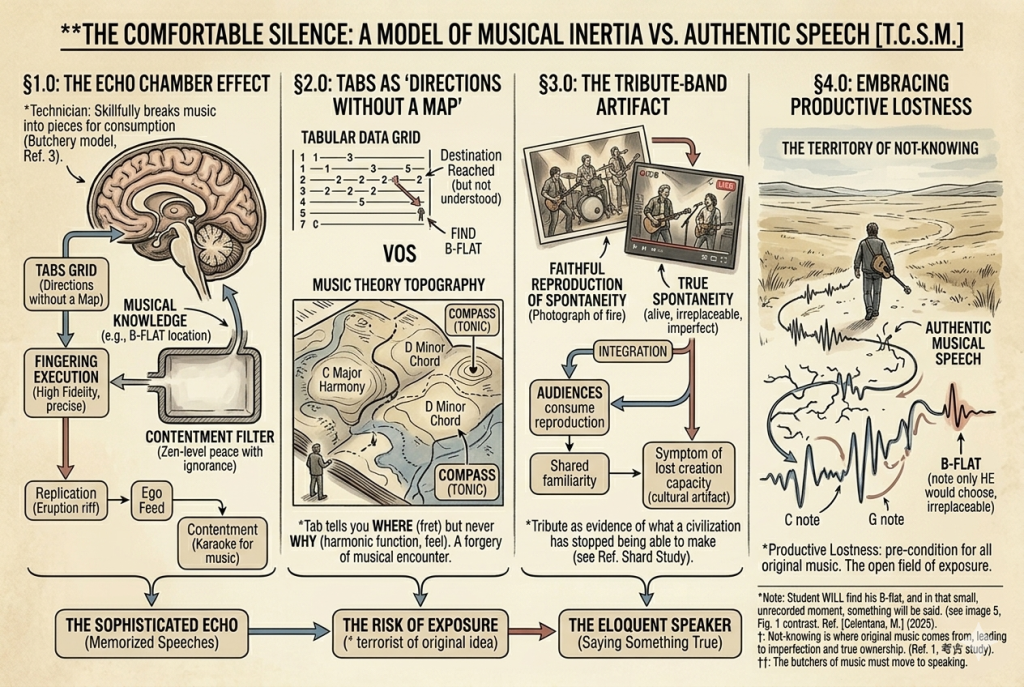
There is a particular kind of young man — and it is, with depressing statistical regularity, a young man — who can play the opening riff of “Eruption” with something genuinely approaching fidelity, whose fingers have logged what the sports-medicine people would call a significant number of hours in the service of replication, who owns three guitars and a pedalboard that costs more than some people’s cars, and who, when asked — gently, carefully, in the way you might ask someone if they’re aware their house is on fire — to find a B-flat, stares back at you with the serene, untroubled expression of someone who has genuinely never considered that this might be a thing he should know.
What’s remarkable isn’t the ignorance. Ignorance is, in the grand scheme of things, fixable. What’s remarkable is the peace. The total, almost Zen-level contentment with a relationship to music that is, if we’re being honest with ourselves and with him, a relationship to music the way that karaoke is a relationship to songwriting. Which is to say: not really.
Here is the thing about tabs — and this will require a brief but necessary detour through linguistics, so bear with me — the thing about tabs is not that they’re wrong, exactly, in the way that a forgery isn’t wrong per se, it’s just that a forgery’s entire reason for existing is to replace your need to encounter the real thing. Tabs tell you where but have absolutely nothing to say about why, and the why — the question of why this note, here, now, after that note, producing this feeling in the chest of someone listening in a car at 2am — is, I would argue (and I recognize this is not a modest claim), the only question in music that actually matters.
The rest is fingering.*
*(And yes, that’s a technical term. Though the double meaning is, in this context, not entirely accidental.)
—
Consider, if you will, the tribute band. Not as a curiosity, not as a punchline, but as a cultural artifact — the way an archaeologist might consider a shard of pottery, which is to say: as evidence of what a civilization valued, and perhaps more importantly, what it had stopped being able to make.
Within a ten-mile radius of where I live, there are venues — actual venues, with stages and sound systems and people who get paid to run lights — that are devoted, with a commitment that I can only describe as monastic, to the reproduction of music made by people who are either dead or so famous they will never, under any circumstances, be in this particular room on this particular Friday night. You can see a Pink Floyd tribute. You can see a Pearl Jam tribute. You can see — and I want you to really sit with this — a Grateful Dead tribute band, which is a thing that exists in the world and requires, if you think about it for more than thirty seconds, a complete and total surrender to a kind of irony so dense it has its own gravitational field, given that the Grateful Dead were, whatever else you want to say about them, a band whose entire aesthetic identity was built around the idea that no two performances were alike, that the music was alive, that it was going somewhere, and the somewhere was always and specifically unknown. A Grateful Dead tribute band is, in other words, a band that has dedicated itself to the faithful reproduction of spontaneity. Which is not spontaneity. Which is, in fact, the opposite of spontaneity, in the same way that a photograph of a fire is the opposite of warm.
And the audiences come. This is the part I find myself returning to, the part that catches in the throat a little. The audiences come. They wear the shirts. They know the words. They have, in some cases, seen the original band — the actual Fleetwood Mac, the actual Pearl Jam — and they are here anyway, in a mid-sized venue on a Tuesday, watching people they’ve never heard of play songs they’ve heard a thousand times, and they are happy. Or something that looks enough like happiness that the distinction might not matter.
I don’t say this to be cruel. I say this because it is a symptom, and symptoms — ask any doctor who is also, apparently, a music teacher — are worth paying attention to.
—
I have a student — I’ll call him what he essentially is, which is Exhibit A — who is, by any technical measure, an impressive guitarist. His hands do things that took him years to teach them, and the years show. He is fast where fast is called for and precise where precision matters and he has, genuinely, a feel for certain kinds of music that you cannot entirely teach and that I therefore cannot entirely take credit for.
He cannot find a B-flat.
I don’t mean this metaphorically, though it is also metaphorical. I mean that if you sit across from him with a guitar in your lap and say “play me a B-flat, anywhere on the neck, any octave, take your time” — the expression that crosses his face is not the expression of someone searching. It is the expression of someone who has just been asked for directions to a city he didn’t know existed. There is no internal map being consulted. There is no map.
What there is, instead, is tab. There has always been tab. Tab, for those mercifully unfamiliar, is a system of guitar notation that tells you which fret to press on which string, and which tells you absolutely nothing else — not the name of the note, not its relationship to the notes around it, not why it sounds the way it sounds or feels the way it feels or means what it means in the particular harmonic universe of the song you’re playing. Tab is, to put it plainly, directions without a map. It will get you to the destination. It will never, under any circumstances, teach you where you are.
My student has been to many destinations. He has learned, with genuine dedication, to replicate the output of people who knew where they were going. He has, in the language of our earlier metaphor — the one about eloquence and echo — memorized a very impressive number of speeches.
When I point this out, gently, in the way that you point out to someone that the foundation of their house has a crack in it, he reacts with something that is almost wonder. Wow, he says. I didn’t realize I didn’t know so much. And then, and this is the part that is equal parts heartbreaking and instructive, the wonder fades, and the contentment returns, and next week he comes back having learned another song from tab, having added another destination to a map he will never own, and the B-flat is still out there somewhere, unplayed, waiting.
This is not a story about talent. He has talent. This is a story about risk — specifically, about the elaborate and ingenious and almost admirable lengths to which human beings will go to avoid the particular risk of having something to say.
—
Because that’s the real terror, isn’t it. Not failure. Not even embarrassment. It’s the specific, singular horror of exposure — of standing in the open field of an original idea, something that came from inside you, something that is therefore a direct and non-negotiable referendum on your interior life, and discovering that the world would have preferred “Don’t Stop Believin’.”
And look — I have sympathy. I want to be clear that I have genuine, non-ironic sympathy for the impulse. There is a real and human pleasure in shared cultural touchstones, in the collective recognition of a familiar chord progression, in watching a room of strangers briefly become something like a community over the bridge of a song they all already know. That’s not nothing. That’s actually something quite beautiful, if you want to be generous about it.
But here is what it is not: it is not the practice of music in any sense that the word “practice” should be allowed to retain. It is the performance of familiarity. It is, to return to the linguistic framework that is apparently where I live now, the equivalent of a man who has memorized every great speech in the English language and can deliver them with perfect diction and appropriate emotional affect, and who has never, not once, said a single word that was his own.
We would not call that man eloquent.
We would not, if we’re being honest, call him a speaker at all.
We would call him, with the specific admixture of pity and unease that the situation warrants, something closer to a very sophisticated echo.
And the tragedy — the part that arrives at around 2am, uninvited, in the way that the real things always do — is that most of these people, the technicians and the tab-followers and the tribute-band lifers, are not stupid. They are not untalented. They have put in hours. They have bled on fretboards, metaphorically and in several cases literally. They have the chops, as we say, which is a word I’ve always found interesting because chops are what a butcher has, and what a butcher does, with great skill and efficiency, is break something down into pieces that are easier for other people to consume.
Which is fine, if what you want to be is a butcher.
—
Here is what I want to say to my student, and to everyone who has ever hidden behind a tab book or a tribute setlist or the reliable comfort of someone else’s chord progression, and what I find, most days, that I lack either the cruelty or the courage to say directly:
You already have something to say.
This is not a motivational poster. This is not the part where I tell you that you’re special and your voice matters and the world is waiting. I have no particular interest in that kind of reassurance, and neither, I suspect, do you. What I mean is something more specific, more structural, more — if you’ll forgive the term — grammatical. The capacity for musical speech is not a gift distributed to a chosen few. It is not, despite everything the music industry has spent decades trying to convince you of, a form of magic. It is a language. And language — real language, the kind that means something, the kind that changes the air in a room — is not learned by memorizing other people’s sentences. It is learned, slowly and badly and with a great deal of embarrassing failure, by trying to say something true.
My student, the one who cannot find B-flat, is not incapable of finding it. He is unwilling — and I mean this with more compassion than the word usually carries — to enter the territory where not-knowing lives. Because not-knowing is where all original music comes from. It is the necessary precondition. You have to be lost before you can find anything worth finding, and the people who have given us the music that actually matters — the music that finds you in a car at 2am and makes you feel, absurdly but undeniably, like someone else has been inside your specific sadness — those people were, at the moment of creation, profoundly, productively, courageously lost.
The tribute band is not lost. The tab is not lost. They know exactly where they’re going, and that, finally and precisely, is the problem.
Because music — real music, music that is alive — does not go where it knows. It goes where it must. It goes into the open field, into the exposure, into the terrifying and necessary country of I don’t know if this is any good but it is true and it is mine, and it stays there, and it makes something, and the something is always — always — imperfect and always — always — irreplaceable.
My student will find his B-flat. I believe this the way I believe most things I cannot prove — stubbornly, irrationally, on the basis of insufficient evidence and thirty years of watching people surprise themselves. He will find it, and then he will find the note that comes after it, the one that only he would choose, the one that no tab will ever tell him to play, and in that moment — that small, unwitnessed, unrecorded moment in a lesson room that smells like guitar polish and old carpet — something will have been said.
That’s all any of us are trying to do, in the end.
Say something.
if this essay did something to you — cracked something open, confirmed a suspicion you'd had for years but never had words for, or simply made you feel less alone in your relationship with music — there's more where that came from. music as language is a publication about exactly what it sounds like: the idea that music isn't a metaphor for communication, it is communication, and that every person alive is already fluent in ways they haven't yet been told. new essays arrive when they're ready, which is to say: not on a schedule, but not randomly either — the way a good melody arrives. subscribe at michaelcelentana.substack.com and i'll meet you there.