31. March 2026
Effortless
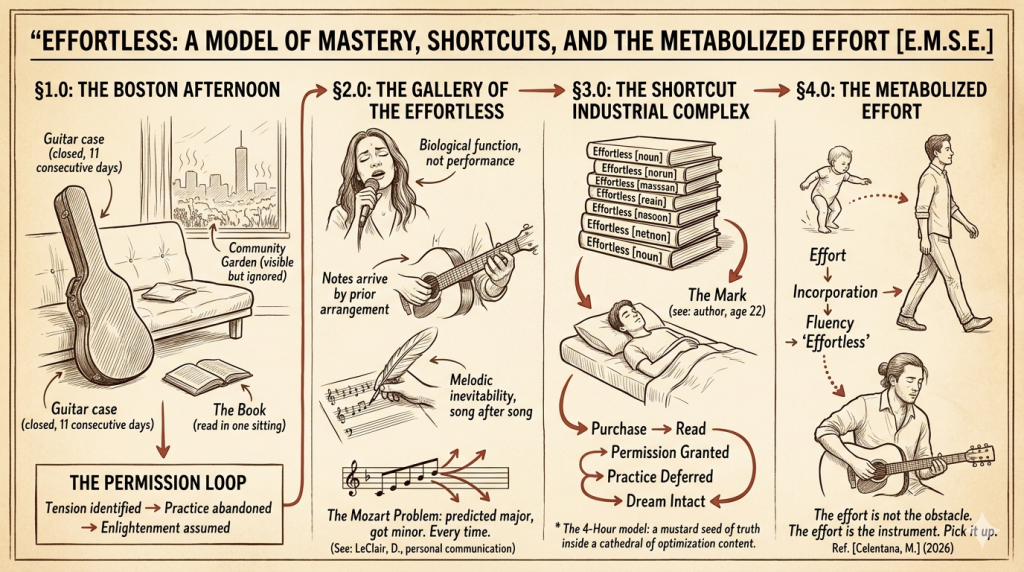
The summer I turned twenty-two, I lived in a first-floor apartment in Boston with no air conditioning and a view of the Prudential Tower that the landlord had described, with the unbothered confidence of a man who has never been contradicted, as “panoramic.” It was panoramic in the sense that I could see quite a lot of sky above the Prudential Tower. The apartment itself was approximately the temperature and humidity of a dog’s mouth. I had a guitar, a futon, and the particular species of ambition that afflicts conservatory students who have recently learned that they are not, in fact, the most talented person in the room—which is to say, an ambition seasoned generously with panic.
Below my window was a community garden—a modest grid of raised beds tended by neighbors who arrived early in the morning with watering cans and left with dirt under their fingernails and, presumably, some version of satisfaction that I could not yet identify.[1] Beyond the garden sat a park that was, by all appearances, a park: benches, pigeons, men sitting alone with newspapers. I did not yet understand the park’s secondary function, its role as a kind of open-air marketplace for certain transactions between consenting adults who preferred efficiency to courtship.[2] But I understood the Prudential Tower, and the humidity, and the guitar case leaning against my futon, and the book in my hands, which promised—right there on the cover, before I’d turned a single page—that the thing I wanted most in the world could be had without the thing I least wanted to do.
The book was Kenny Werner’s Effortless Mastery: Liberating the Master Musician Within.[3]
I read it in one sitting. I did not pick up my guitar once. Because I didn’t need to. It was, the title assured me, effortless.
I want to be fair to Werner, because the book deserves fairness, and because what I’m about to say about its title is not, finally, about the book itself. Effortless Mastery is, in its substance, genuinely useful—more useful, probably, than ninety percent of what passes for music pedagogy. Werner’s central argument is that most musicians carry enormous physical and psychological tension into their playing, and that this tension—this clenching against failure, this white-knuckled death grip on the instrument and on the hope of getting it right—is itself the primary obstacle to the musical freedom they’re pursuing. He proposes a meditative practice: full-body awareness, the systematic identification and release of hidden tension, a willingness to play from a place of surrender rather than conquest. The master musician, Werner suggests, is not the one who has accumulated the most technical ammunition but the one who has learned to get out of their own way.
This is, I want to be unambiguous, a true and important insight. Any musician who has experienced a moment of genuine flow—where the instrument disappears and you are simply inside the music, responding to it in real time, hearing it and speaking it simultaneously—knows that Werner is describing something real. The problem is not the book. The problem, as with most things, is the distance between what a book says and what a desperate person hears.
What I heard, that afternoon in the dog’s mouth of my Boston apartment, was roughly this: You were right all along. The effort is the problem. The scales are the problem. The arpeggios, the transcriptions, the four-hour practice sessions that leave your fingertips grooved and your back aching—all of it was not merely unnecessary but actively counterproductive. You have been digging a hole to get to the sky.
What I heard was permission.
Permission to close the guitar case. Permission to replace the drudgery of actual practice with a full-body scan of the hidden tensions that were, the book now revealed, the root cause of my mediocrity. I lay on my futon in the Boston heat and conducted a thorough internal audit of my physical being. I found tension everywhere. My shoulders: tense. My jaw: tense. My hands, which had been playing guitar for six years (just six? how I was accepted into what most people would consider a prestigious music school with so little experience was, in hindsight, an economic choice made by a school described cuttingly by one of my professors as a “cash cow” but this is a subject for another essay): very tense. The diagnosis was clear. The prescription was rest. The prognosis was Metheny.[4]
I closed my eyes and felt the tension leave my body like steam from a manhole. The Prudential Tower shimmered in the haze. Below, in the community garden, someone was on their knees in the dirt, pulling weeds from a tomato plant that would not fruit for months. I felt sorry for them. They hadn’t read the book.
Part of what makes the effortless fantasy so seductive is that it has, if you squint, evidentiary support. There exists a constellation of musicians who seem to be doing precisely what Werner describes, and doing it at a level so elevated that the effort is genuinely invisible.
Stevie Wonder sings the way other people breathe. There is no visible mechanism, no apparent strain, no moment where you can catch him calculating. He opens his mouth and what comes out is so fully formed, so metabolically integrated, that it seems less like a performance than a biological function. Watching Stevie sing is like watching someone’s heart beat: you know, intellectually, that there’s a staggeringly complex system at work, but the output is so seamless that the complexity becomes invisible.
Pat Metheny’s hands, when he improvises, appear to always be in the most comfortable position on the fretboard. He doesn’t reach for notes; they seem to arrive under his fingers by prior arrangement, as though the guitar and his nervous system have been in a private negotiation that resolved in advance of the performance. He can, apparently, improvise anything, at any moment, in any context. He moves between harmonic worlds the way a polyglot switches languages at a dinner party—without the pause that betrays translation.[5]
Lennon and McCartney wrote melodies you can remember after one listen. Song after song after song, each one hooking into your auditory cortex with the precision of a surgical instrument. Not one is forgettable. The sheer volume of their output at that level suggests either divine intervention or a melodic fluency so deep that the generation of memorable melody was, for them, a natural byproduct of being conscious.
And then there is Mozart, the ur-example, the original effortless genius, who by all accounts was speaking music—not playing it, not performing it, but speaking it—by the age of five. A professor of mine, Dennis LeClair, told a story from his conservatory days that I have never forgotten. LeClair’s roommate put on a Mozart piece, and LeClair, with the confidence of a young musician who has recently discovered Roman numeral analysis, announced that Mozart bored him. He could always guess where the music was going. The roommate, who apparently had the patience of a saint, suggested they test this. They sat down and LeClair attempted to predict, in real time, where Mozart’s melodic and harmonic lines would move. He was wrong every single time. When he guessed major, Mozart went minor. When he guessed the dominant would resolve to the tonic, Mozart modulated to an entirely different key. When he tried to guess which key, he was off by a nautical mile. The music that had sounded inevitable—that had sounded easy, even boring in its apparent predictability—turned out to be operating at a level of sophistication so far beyond LeClair’s analytical capacity that his predictions were functionally random.
This is the trick of mastery. It looks effortless specifically because the effort has been so complete that it has become invisible. Mozart didn’t bypass complexity. He metabolized so much of it that his output achieved the illusion of simplicity—the way a river looks calm on the surface precisely because the current underneath is so powerful and so organized that there is no turbulence left to see.
We live, of course, in the golden age of the shortcut. The shelves—physical and digital—groan under the weight of promises that mastery is available at a discount, that the long way around is for suckers, that somewhere there exists a hack, a trick, a four-hour workaround that will collapse the distance between where you are and where you want to be.[6]
Tim Ferriss will teach you a language in four hours. YouTube will teach you jazz in thirty days. An app will teach you guitar while you sleep—or close enough to sleeping that the distinction is, for marketing purposes, immaterial. The entire self-help publishing economy runs on a single insight, understood with predatory clarity: people will pay real money for permission to stop struggling. Not for the cessation of struggle itself—that would require actual transformation, which is expensive and slow and cannot be shipped in two days with Prime. But for the permission. For the absolution. For the book that says, with the authority of a cover price and an author bio, that the reason you haven’t yet achieved what you want is not that you haven’t done enough work but that you’ve been doing the wrong work, and the right work is, conveniently, less.[7]
Consider what “effortless” means in other contexts, and how quickly the absurdity reveals itself. No one sells a book called Effortless French. Or rather—and this is important—someone probably has, and it probably sold well, and the person who bought it probably still does not speak French. Because the acquisition of French is not a matter of technique or mindset or the identification of hidden tensions in your relationship with the subjunctive. It is a matter of hours. Of years. Of mispronunciation and embarrassment and the slow, humbling accumulation of a vocabulary that will, for a very long time, be insufficient to say what you actually mean. You know this. Everyone knows this. And yet the dream persists—the dream that fluency can be had without immersion, that speaking can be achieved without the stammering that precedes it.
Or consider walking. No one writes Effortless Walking: Liberating the Master Pedestrian Within, because we all understand, at some pre-verbal level, that walking required years of catastrophic failure. You fell down thousands of times. You grabbed furniture, shins, the family dog. You bruised your knees and your dignity in roughly equal measure. And then one day you walked, and the effort disappeared—not because it was never necessary, but because your body had absorbed it so completely that it became indistinguishable from being alive. The mastery of walking is, in fact, effortless. But the acquisition of that mastery was anything but. We simply have the good fortune of not remembering it.
This is the sleight-of-hand at the core of every shortcut promise: the conflation of the experience of mastery with the process of mastery. Yes, the master musician plays effortlessly. Yes, the fluent speaker speaks effortlessly. But the effortlessness is not a method. It is a destination. And the only vehicle that goes there runs on the very thing the title tells you to leave behind.
Here is the part I could not have written at twenty-two, because at twenty-two I did not yet have the vocabulary for it, and because the vocabulary, when it came, came not from a book but from the slow accumulation of years spent in rooms with students who were, in ways I could finally recognize, doing the same thing I had done on that futon in Boston.[8]
The young guitarist who arrives at a lesson and says she hasn’t practiced—she’s not lazy. Or she might be, but the laziness is a symptom, not a cause. Underneath it is something harder to name: the suspicion that practice will reveal a ceiling. That effort will deliver a verdict. That if she really, truly commits—if she does the scales, the arpeggios, the transcriptions, the four-hour sessions—she will find out, with the finality of a medical diagnosis, that she is not what she hopes she is. And so she doesn’t practice. And the dream stays intact. And the guitar case stays closed, leaning against the futon, a monument to potential that is more comfortable unexamined.
I know this because I was this. On that humid afternoon in Boston, with the Prudential Tower shimmering and the gardeners gardening and the men in the park finding each other with the efficiency of people who have decided to skip the uncertain middle part, I was not embracing Werner’s philosophy of surrender. I was hiding from the possibility that surrender wouldn’t be enough. That even after I released every tension, identified every hidden blockage, achieved every meditative state the book described—I might still not be Metheny. I might still not be Stevie. I might still be exactly what I was: a twenty-two-year-old with a good ear and medium-fast fingers and the sinking feeling that the distance between “good” and “great” was not a distance that could be closed by any book, effortless or otherwise.
The guitar case stayed closed for almost two weeks. The effortless period. The vacation from the verdict.
Here is what I know now, twenty-five years into a life spent playing, teaching, and thinking about music, that I could not have known then:
Werner was right. And the title was wrong. And these two things are not in contradiction.
He was right that tension is the enemy of musical expression. Right that musicians carry fear into their playing and that the fear calcifies into physical rigidity and that the rigidity produces the very failures the fear predicted. Right that the path to fluency runs through awareness, through listening, through a willingness to meet the instrument without armor. All of this is true, and I use versions of it in my teaching every day.
But “effortless” is the wrong word. It was always the wrong word. It is wrong in the way that calling the ocean “calm” is wrong—not because there aren’t moments of glassy stillness on the surface, but because the stillness is produced by forces so massive and so continuous that calling them effortless is a category error of the highest order.[9]
What mastery actually feels like—when you are inside it, when the instrument disappears and you are simply speaking the music—is not the absence of effort. It is the complete digestion of effort. The effort has been so thoroughly metabolized, so fully incorporated into who you are, that it no longer registers as something separate from being alive. You don’t try to speak English. But that’s not because English is effortless. It’s because you did the work so long ago, and so completely, that the work has become invisible. The fluency didn’t replace the effort. It is the effort, transformed beyond recognition.
This is what the title should have been. Not Effortless Mastery but something harder to sell, something that wouldn’t move units at airport bookstores, something that would never appear on a cover because no one wants to hear it: Mastery Is What Effort Looks Like After You’ve Forgotten You’re Making It. Or: The Effort Doesn’t Disappear; You Just Stop Noticing. Or, simplest and truest: There Are No Shortcuts.
But that book doesn’t sell. That book sits on the shelf, spine uncracked, while the twenty-two-year-old reaches for the one that tells him what he wants to hear. And he reads it in one sitting, on a humid afternoon, with the guitar case closed and the gardeners gardening and the whole effortful, uncertain, beautiful project of becoming a musician deferred for one more day.
I think about that afternoon sometimes, from the other side of it. From the side where I’ve played ten thousand gigs and taught ten thousand lessons and spent more hours with a guitar in my hands than I could possibly calculate. I think about the young man on the futon, the book on his chest, the case leaning against the wall. I want to tell him something, but I’m not sure he’d hear it. Not because it’s complicated, but because it’s the kind of thing you can only learn by doing the thing it describes, which is the whole infuriating, irreducible point.
The effort is not the obstacle. The effort is the instrument. Pick it up.
if this essay did something to you — cracked something open, confirmed a suspicion you'd had for years but never had words for, or simply made you feel less alone in your relationship with music — there's more where that came from. music as language is a publication about exactly what it sounds like: the idea that music isn't a metaphor for communication, it is communication, and that every person alive is already fluent in ways they haven't yet been told. new essays arrive when they're ready, which is to say: not on a schedule, but not randomly either — the way a good melody arrives. subscribe at michaelcelentana.substack.com and i'll meet you there.
[1]The community garden, I later realized, was the most honest thing visible from that window. People on their knees in the dirt, pulling weeds, watering things that wouldn’t bear fruit for months. Nobody in a community garden is looking for a shortcut. Nobody is reading a book called “Effortless Tomatoes.” They understand, at a cellular level, that the tomato doesn’t care about your schedule, your ambitions, or your desire for efficiency. It will ripen when it ripens. Your job is to show up with water.
[2]There is a subgenre of the shortcut economy that deserves its own sociological study: the park bench. In the park across the street from my apartment, men would arrive alone, sit, wait, make eye contact, and leave together. I am not making a moral judgment here. I am observing that even in the economy of human connection, there exists a version of the transaction that promises to skip the long, uncertain, effortful middle part—the part where you don’t know if the other person likes you, the part where vulnerability is required, the part that is, by any honest accounting, the actual point.
[3]The publishing industry has known for decades that the word “effortless” on a book cover functions as a kind of neurochemical skeleton key. It bypasses the prefrontal cortex entirely and speaks directly to whatever part of the brain is responsible for clicking “Add to Cart” at 2 a.m. Other words in this category include “secret,” “unlock,” and “hack.” All of them promise the same thing: that the obstacle between you and the life you want is not insufficient effort but insufficient information. That somewhere, someone knows the trick. And that this trick can be yours for $24.95.
In the years since the initial publication of Effortless Mastery, the book has reached a fevered, near-cult status among the (mostly) jazz illuminati, who, well, if you know, you know. Suffice to say that this book was required reading if you had any hope of behaving and playing with the breezy confidence of all of those musicians whose abilities were several time zones ahead of yours.
[4]Which, full disclosure, lasted approximately eleven days. On the twelfth day I woke up in a cold sweat, convinced I had forgotten how to play a C major scale, and practiced for four consecutive hours with the kind of frantic intensity usually reserved for people defusing bombs. The effortless period, it turns out, had its own half-life, and that half-life was directly proportional to the distance between my last gig and my next one.
[5]Ask any musician who might reasonably be described as having achieved “mastery” whether they’ve mastered their instrument, and watch what happens to their face. The expression is universal: a kind of amused horror, as though you’ve asked them whether they’ve finished reading. Mastery, for anyone who has approached its neighborhood, reveals itself to be not a destination but a retreating horizon line—the more ground you cover, the more ground there is. Pat Metheny, who practices with a discipline that would make a Benedictine monk nervous, has said in interviews that he feels like he’s just getting started. He is in his seventies.
[6]Timothy Ferriss, to his credit, is not stupid. He is, in fact, quite intelligent, which makes the whole enterprise worse, because he understands exactly what he’s selling. The premise of every “4-Hour” book is that expertise is a function of strategy, not duration—that the reason you haven’t learned to tango is not that you haven’t practiced enough but that you’ve been practicing wrong. Which contains a kernel of truth roughly the size of a mustard seed, around which Ferriss has built a cathedral of optimization content. The problem is not the kernel. The problem is the cathedral.
[7]I want to be careful here, because the self-help critique is itself a genre now, and a fairly smug one, and I don’t want to pretend I’m above any of this. I bought the book. I read it in one sitting. I closed my guitar case with the satisfied air of a man who has just discovered that the diet works while you sleep. I am the mark. I am the target demographic. I am the reason the word “effortless” appears on book covers.
[8]The fear, if I’m being honest—and this is the part I didn’t understand until much later, until I’d logged enough years of teaching to see it in my students’ eyes—is not really that the work is too hard. The fear is that you’ll do the work and discover it wasn’t enough. That you’ll practice your scales for ten thousand hours and still not be Pat Metheny. That the problem was never effort or its absence but something more permanent: a ceiling, a limit, a boundary drawn by genetics or God or the indifferent universe, beyond which your particular set of neural pathways simply cannot pass. Not practicing is, in this light, not laziness. It is a form of protection. You cannot receive a verdict you never submitted to.
[9]You do not “try” to speak English. But you did. For years. With enormous, flailing, saliva-drenched effort. You pointed at things and grunted. You mispronounced everything. You were corrected thousands of times by people who loved you enough to keep correcting. And then one day the effort became invisible—not because it disappeared, but because it became you. Your mouth learned where to put itself. Your brain learned to reach for words without reaching. The fluency didn’t replace the effort. It metabolized it.